Crypto Mutual Fund vs Crypto ETF: What's the Difference?
A crypto mutual fund and a crypto ETF both promise pooled exposure to digital assets, but the similarities largely end there. One prices once a day and — in most cases — is not even a true mutual fund at all; the other trades in real time on a stock exchange for the cost of a single share. One distributes taxable capital gains to every investor annually; the other uses a structural mechanism that sidesteps most of those events entirely. With total crypto ETF assets under management now exceeding $135 billion and over 92 applications pending at the SEC, understanding the difference between a crypto mutual fund vs ETF is essential for any investor evaluating digital asset exposure in 2026.
This guide breaks down the structural, tax, cost, and accessibility differences between crypto mutual funds and crypto ETFs, with specific implications for Indian investors navigating these options through the LRS route.
What Is a Crypto Mutual Fund?
A crypto mutual fund is a pooled investment vehicle registered under the Investment Company Act, US of 1940 that provides exposure to digital assets, priced once daily at its Net Asset Value (NAV, typically calculated at 4 PM ET). Investors buy and sell in dollar amounts, not shares, and transactions settle at the end-of-day NAV regardless of when the order was placed.
In the US, the only true crypto mutual fund currently available to retail investors is the Bitcoin Strategy ProFund (BTCFX), launched in July 2021 as the first publicly available mutual fund offering Bitcoin exposure. BTCFX is registered under the 1940 Act, carries a 1.16% net expense ratio, requires a $1,000 minimum investment, and holds $488 million in AUM as of early 2026. Crucially, BTCFX does not hold spot Bitcoin directly — it invests in Bitcoin futures contracts on the CME through a Cayman Islands subsidiary, which introduces tracking error relative to spot prices.
It is important to distinguish a true crypto mutual fund from other crypto fund products that are often conflated with mutual funds but are structurally different:
The Bitwise 10 Crypto Index Fund is a private placement trust (not a mutual fund), charging 2.50% for investor shares and available primarily to accredited investors. Pantera Capital's Bitcoin Fund is structured as a Cayman hedge fund, not a mutual fund. And Grayscale's Bitcoin Trust (GBTC) operated as a closed-end trust for nearly a decade before converting to a spot Bitcoin ETF in January 2024. During its trust era, GBTC charged a 2.00% management fee and frequently traded at significant premiums or discounts to its underlying NAV. None of these are registered mutual funds under the 1940 Act, and they lack the regulatory protections that come with that registration.
In Canada, CI Global Asset Management launched CI Bitcoin Fund in 2021 — North America's first actual Bitcoin mutual fund — at a 0.40% management fee. It invests through the CI Galaxy Bitcoin ETF. However, no equivalent product exists in the US or India.
What Is a Crypto ETF?
A crypto ETF (exchange-traded fund) holds digital assets or crypto-related securities and trades on a stock exchange throughout market hours, just like any equity. Investors buy and sell in shares at real-time market prices, with no minimum investment beyond the cost of a single share. BlackRock's iShares Bitcoin Trust (IBIT), the largest spot Bitcoin ETF at $66.9 billion in AUM as of May 2026, trades on NASDAQ at approximately $44 per share with a 0.25% sponsor fee.
The crypto ETF market has expanded dramatically since the SEC approved the first 11 spot Bitcoin ETFs in January 2024. Spot Ethereum ETFs followed in July 2024, Solana ETFs launched in October 2025, and XRP ETFs were approved in early 2026. The total crypto ETF ecosystem now includes products tracking at least four major digital assets, with applications pending for many more.
A landmark development came in September 2025 when the SEC approved generic listing standards for spot crypto ETFs, reducing the approval timeline from over 240 days to approximately 75 days. This structural change removed the case-by-case review bottleneck that had delayed crypto ETF launches for years and opened the floodgates for new products.
Most recently, BlackRock launched the staked Ethereum ETF (ETHB) in March 2026, which stakes approximately 80% of its ETH holdings on-chain and passes roughly 82% of the gross staking rewards (currently ~3.1% annually) to investors. This represented a structural innovation unavailable in traditional mutual fund formats: yield generation from a passive crypto holding.
Head-to-Head: Crypto Mutual Fund vs Crypto ETF
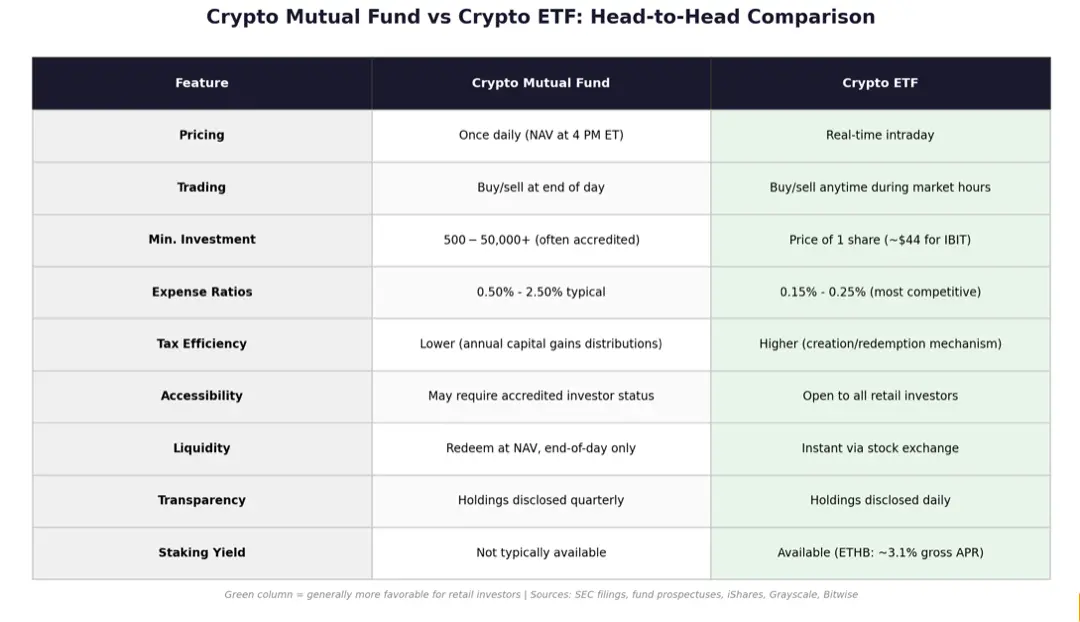
Figure 1: Crypto Mutual Fund vs Crypto ETF Comparison (Sources: SEC filings, fund prospectuses)
Feature | Crypto Mutual Fund | Crypto ETF |
Pricing | Once daily (NAV) | Real-time intraday |
Trading | End of day only | Anytime during market hours |
Minimum Investment | $500 - $50,000+ | Price of 1 share (~$44 IBIT) |
Expense Ratio | 0.50% - 2.50% | 0.15% - 0.25% (most) |
Tax Efficiency | Lower (gain distributions) | Higher (creation/redemption) |
Accessibility | Often accredited only | All retail investors |
Liquidity | Redeem at NAV | Instant via exchange |
Transparency | Quarterly disclosures | Daily disclosures |
Staking Yield | Not available | Available (ETHB ~3.1%) |
On nearly every metric that matters to retail investors, crypto ETFs hold a structural advantage over any crypto mutual fund or private fund alternative. The exceptions are narrow: mutual funds may offer automatic reinvestment features and retirement account compatibility, while private funds can sometimes accommodate very large institutional allocations more flexibly. But for cost, accessibility, transparency, and tax efficiency, the ETF wrapper has become the dominant vehicle for crypto exposure.
Expense Ratios: The Cost Gap Is Enormous
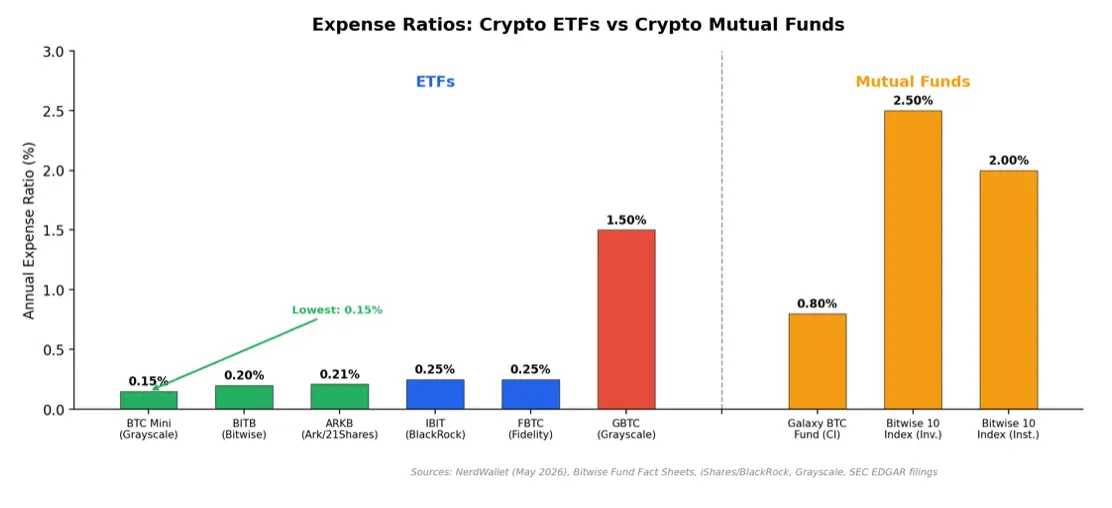
Figure 2: Expense Ratio Comparison (Sources: NerdWallet, Bitwise Fact Sheets, iShares, Grayscale)
The fee differential between crypto mutual funds (and fund-like products) and crypto ETFs is one of the starkest in all of asset management. The Grayscale Bitcoin Mini Trust charges just 0.15% annually, the lowest in the spot Bitcoin ETF category. IBIT and FBTC charge 0.25%. By contrast, the only true crypto mutual fund — BTCFX — charges 1.16%, while private fund structures like the Bitwise 10 Crypto Index Fund charge 2.50% for investor shares. Even GBTC, after its ETF conversion, still carries a 1.50% fee.
To put this in perspective: on a $100,000 investment held for five years with identical returns, the difference between a 0.25% ETF fee and a 1.16% mutual fund fee amounts to over $4,500 in lost returns. Against a 2.50% private fund fee, the gap exceeds $11,000 — and over a decade it exceeds $25,000. In crypto, where long-term compounding is the entire thesis for most investors, expense ratios matter enormously.
Tax Efficiency: Why the ETF Structure Wins
The tax advantage of ETFs over mutual funds is structural, not circumstantial. When a mutual fund investor redeems their shares, the fund must sell underlying assets to raise cash. If those sales generate capital gains, the fund is required to distribute those gains to all shareholders at year-end, even those who did not redeem. This means you can owe taxes on gains you never personally realized.
ETFs avoid this through the creation/redemption mechanism. When large investors (authorized participants) want to exit, they exchange ETF shares for the underlying asset in-kind, rather than forcing a cash sale. This process does not trigger a taxable event for the fund, meaning remaining shareholders are not burdened with capital gains distributions they did not initiate.
For US-based investors, this difference is significant. For Indian investors accessing US crypto ETFs via the LRS route, the advantage compounds further: US Bitcoin and Ethereum ETFs are classified as foreign assets under Indian tax law and attract 12.5% LTCG after a 24-month holding period, compared to the 30% flat tax on direct crypto under Section 115BBH. The ETF wrapper combined with the LRS route remains the most tax-efficient path to crypto exposure from India.
The 2024-2026 Crypto ETF Explosion
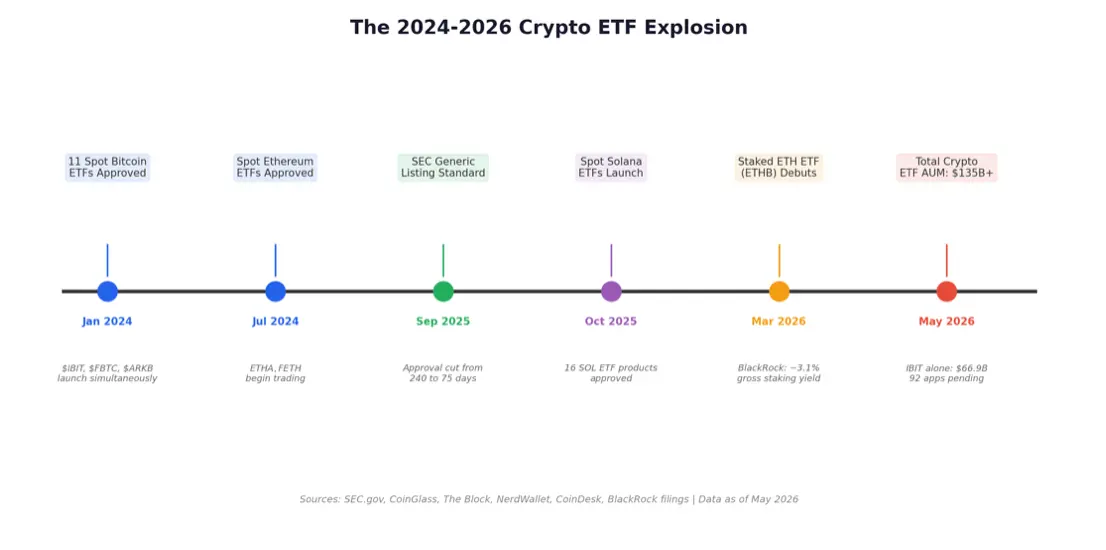
Figure 3: Crypto ETF Timeline 2024-2026 (Sources: SEC, CoinGlass, The Block, CoinDesk)
The crypto ETF landscape has transformed completely in just two years. In January 2024, the SEC approved 11 spot Bitcoin ETFs simultaneously. By May 2026, the ecosystem includes spot Bitcoin ETFs ($90B+ AUM), spot Ethereum ETFs ($12B+ AUM), 16 spot Solana ETFs, spot XRP ETFs (over $1.5B in inflows since launch), and the first staked Ethereum ETF (ETHB). Total crypto ETF AUM exceeds $135 billion.
The SEC's September 2025 generic listing standards were the catalyst. By removing the need for individual, case-by-case reviews, the SEC signalled that crypto ETFs would be treated as mainstream financial products rather than novel instruments requiring special scrutiny. The result: 92 crypto ETF applications now pending, covering at least 24 different tokens and token combinations.
Crypto mutual funds and private crypto funds, by contrast, have not seen comparable growth. BTCFX remains the only true crypto mutual fund in the US, with $488 million in AUM — a fraction of IBIT's $66.9 billion. The private fund structures that existed before the ETF era, including Grayscale's trusts, Pantera's hedge funds, and Bitwise's private trust products, have either converted to ETFs, remained niche products for accredited investors, or seen AUM stagnate as capital flows into the cheaper, more accessible ETF alternatives.
India-Specific: Which Route Works for You?
No domestic crypto mutual fund or crypto ETF exists in India as of May 2026. As covered in detail in our guide on why no crypto mutual fund exists in India yet, the three-way regulatory deadlock between SEBI, the RBI, and the Finance Ministry has prevented any crypto-linked fund product from launching domestically.
For Indian investors, the practical comparison is between accessing US crypto ETFs via the LRS route versus using domestic alternatives like crypto SIPs on Indian exchanges. The LRS route offers structural advantages: ETF-level expense ratios (0.15-0.25%), institutional-grade custody, and a significantly lower tax rate (12.5% LTCG after 24 months as a foreign asset, versus 30% flat on direct VDA). The trade-offs are the $250,000 annual LRS limit, 20% TCS on remittances exceeding Rs 10 lakh, and the need for an international brokerage account.
For investors who prefer domestic simplicity, crypto SIPs on platforms like CoinDCX and CoinSwitch start at Rs 100/month with no minimum lock-in, though all gains are taxed at the flat 30% rate under Section 115BBH. Managed crypto portfolio platforms like Grade Capital offer a middle ground — providing professional allocation, systematic rebalancing, and portfolio-level risk management without requiring investors to navigate international brokerage accounts or the LRS process. However, the tax treatment at Grade Capital, is of business income slab because they deal with derivatives of crypto which is taxed under section 43(5)A.
Disclaimers
Performance Disclaimer: Past performance of any investment, including cryptocurrencies, crypto ETFs, and crypto mutual funds, is not indicative of future results. Returns can vary significantly, and investors may lose part or all of their capital.
Tax Disclaimer: Tax information presented in this article is based on the Income Tax Act as applicable in FY 2025-26 and US tax principles for general informational purposes only. Tax laws are subject to change. Consult a qualified tax advisor before making investment decisions based on tax considerations.
General Disclaimer: This article is for informational and educational purposes only and does not constitute financial, investment, or legal advice. Grade Capital is not a mutual fund or ETF. Cryptocurrency investments are subject to market risks, regulatory risks, and technological risks. Always conduct your own research and consult qualified professionals before investing.