What Is a Crypto Basket? The Simple Version
Think of it like ordering a thali at a restaurant.
You could walk up to the counter and order each dish individually — the dal, the roti, the sabzi, the rice, the dessert. You would need to decide what goes well together, how much of each to order, and whether the combination is balanced. That takes time, knowledge, and a fair amount of effort.
Or you could order a thali. Someone who knows food has already put together a balanced meal. You sit down and eat.
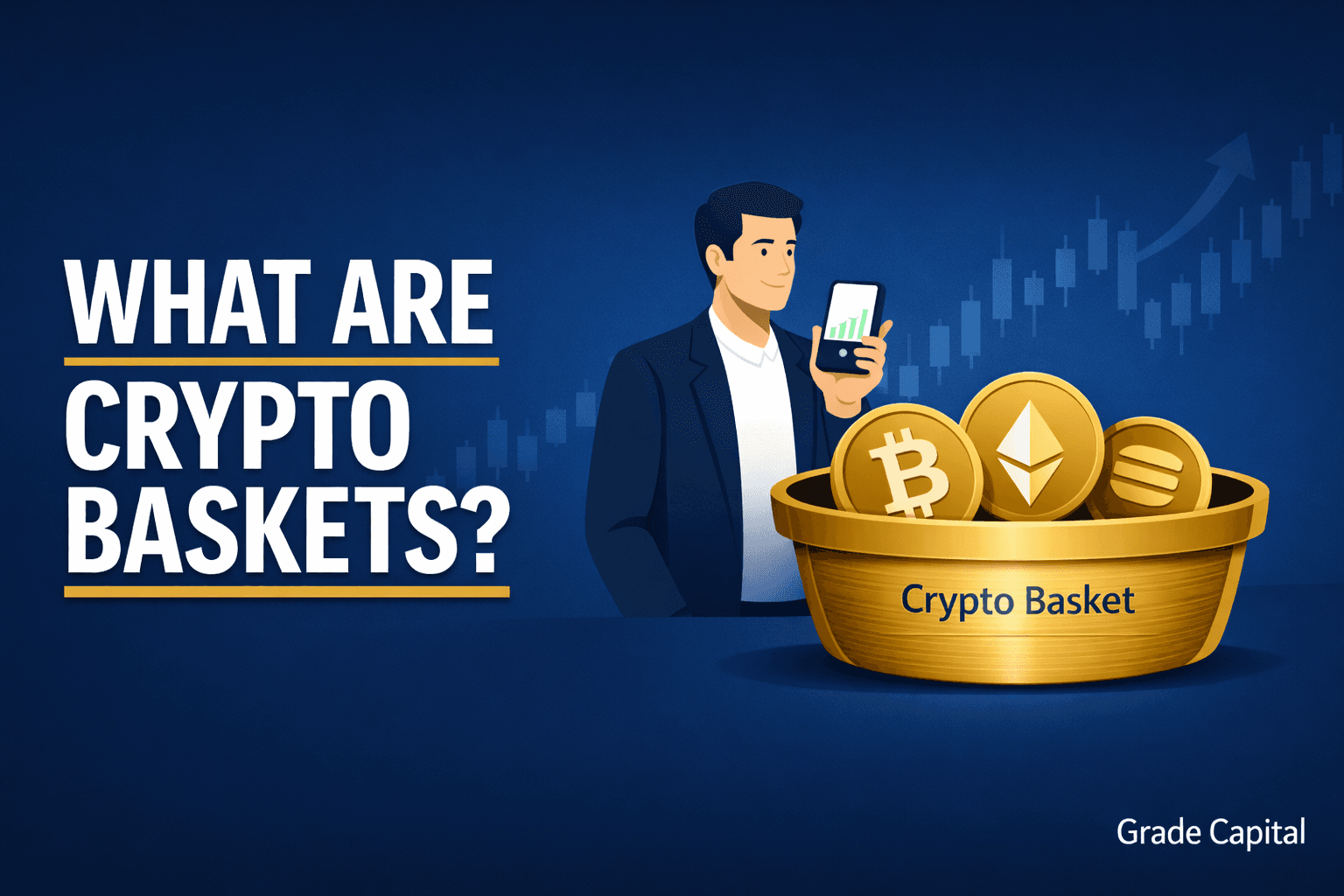
A crypto basket works the same way. Instead of picking individual cryptocurrencies — Bitcoin, Ethereum, Solana, and so on — you invest in a pre-built portfolio that bundles several of them together. The selection, the allocation, and the rebalancing are handled for you.
The key components are straightforward. You invest a lump sum amount. That amount gets allocated across multiple cryptocurrencies according to the basket's strategy. A NAV (Net Asset Value) is calculated daily — this is your scorecard, telling you how your basket is performing on any given day. It works exactly like the NAV you see for mutual funds.
How Do Crypto Baskets Work?
The mechanics are simpler than most people expect.
You choose a basket that matches your investment goals. You invest a lump sum — the minimum varies by platform, but it can start as low as ₹12,000. Your money gets allocated across the basket's holdings according to its defined strategy. From that point forward, the basket is managed — either passively or actively, depending on the type of basket you have chosen.
Daily NAV tracking gives you visibility into performance. You can see exactly what your investment is worth on any given day, just as you would with a mutual fund. There is no need to open a trading app at 2 AM to check if Ethereum moved.
Rebalancing happens within the basket. As market conditions change, the basket adjusts its positions. In a passively managed basket, this might mean periodic reweighting. In an actively managed basket, this could mean much more — but we will get to that distinction shortly.
The point is this: your job as an investor is to choose the right basket and invest. The basket does the rest.
Why Not Just Buy Individual Coins?
It is a fair question. If you believe in Bitcoin, why not just buy Bitcoin?
There are a few reasons why baskets often make more sense, especially for investors who are not full-time crypto traders.
Diversification reduces single-coin risk. If you put everything into one cryptocurrency and that coin drops 50%, your entire portfolio drops 50%. A basket spreads your exposure across multiple assets, so no single coin can sink your investment.
Emotional discipline is built in. When you manage your own portfolio, every red candle on a chart tempts you to panic sell. Every green candle tempts you to buy more at the top. Baskets remove you from the day-to-day emotional cycle. The strategy runs regardless of how you are feeling on a Tuesday morning.
Time savings are significant. Researching coins, tracking market movements, reading technical charts, deciding when to buy and sell — this is a part-time job. Most investors would rather allocate their time elsewhere.
Here is how the two approaches compare:
Factor | Buying Individual Coins | Crypto Basket |
|---|---|---|
Diversification | You build it yourself, coin by coin | Built into the basket by design |
Decision-making | Every buy/sell is your call | Handled by the basket strategy |
Time required | High — daily monitoring needed | Low — invest and track NAV |
Emotional discipline | Entirely up to you | Removed from the equation |
Professional management | None | Available in managed baskets |
NAV tracking | No standard metric | Daily NAV like a mutual fund |
Individual coin investing has its place — particularly for experienced traders who enjoy the process. But for investors coming from a mutual fund background, baskets offer a far more familiar and manageable structure.
Not All Crypto Baskets Are the Same
This is where most guides stop. They explain what a crypto basket is, and they move on. But there is a critical distinction that changes everything — and most Indian investors do not know about it yet.
There are two fundamentally different types of crypto baskets.
Type 1: Spot Baskets. These are the most common. A spot basket simply buys and holds actual cryptocurrencies. If the basket contains Bitcoin, Ethereum, and Solana, it literally owns those coins. When prices go up, your basket goes up. When prices fall, your basket falls right along with them.
Spot baskets are like an open jeep on a road trip. On a sunny day, it is a great ride. But when it rains, you get drenched. There is no roof, no protection. You are fully exposed to whatever the weather — or in this case, the market — decides to do.
Type 2: Strategy-Based Baskets. These baskets do not just hold coins. They use financial strategies that can generate value regardless of which direction the market moves. Some of these strategies are designed to profit when the market goes up, others when it goes down, and some when it simply moves in either direction.
A strategy-based basket is like a car with a roof, air conditioning, and all-weather tyres. It does not matter if it is sunny or raining — you keep moving.
Platforms like Grade Capital offer strategy-based baskets that include options positions, futures instruments, and even a portion allocated to high-quality debt funds. The combination is designed to grow the NAV consistently — not by chasing every Bitcoin rally, but by generating returns across different market conditions.
This is a fundamentally different proposition from a spot basket. And it carries a different tax treatment too — which we will cover next.
How Can a Basket Grow When the Market Falls?
This is usually the part where people pause. If crypto prices are falling, how can a basket possibly make money?
The answer lies in how strategy-based baskets are built. They do not rely on crypto prices going up. They use multiple layers that work together, each designed to earn in different conditions.
Layer 1: Options strategies that profit from market movement. Without getting into complex finance terminology, here is the simple version. Certain positions within the basket are structured to gain value when the market moves sharply — in either direction. It does not matter whether Bitcoin goes up or down. What matters is that it moves. Think of it as being paid for volatility itself, not for guessing the direction.
Layer 2: Futures positions that profit from falling prices. When market conditions indicate a likely decline, the basket can take positions that directly benefit from that fall. This is something a spot basket simply cannot do. A spot basket can only sit and watch as prices drop. A strategy-based basket can actively earn during that drop.
Layer 3: Debt fund allocation for steady returns. A portion of the basket is invested in high-quality debt instruments — think of this as the stable, fixed-income layer. It earns steady returns regardless of what the crypto market is doing on any given day. While it will not deliver dramatic returns on its own, it provides a consistent base that smooths out the overall performance.
The combined effect: The basket is not trying to catch every Bitcoin pump. It is not trying to predict every crash. It is designed to generate consistent returns throughout the year — capturing enough of the upside while staying protected on the downside.
The goal is not to beat Bitcoin on its best day. The goal is to beat doing nothing on every other day.
How Are Crypto Baskets Taxed in India?
Tax treatment is one of the biggest differences between spot baskets and strategy-based baskets — and it is one that most investors overlook entirely.
Spot crypto baskets fall under the VDA (Virtual Digital Asset) tax framework. Under Section 115BBH of the Income Tax Act, any gains from selling VDAs are taxed at a flat 30%. No exceptions. You cannot deduct expenses. You cannot offset losses from one coin against gains from another. You cannot carry forward losses to future years. It is a blunt, one-size-fits-all tax.
Derivatives-based baskets (those using options and futures) are treated differently. Income from crypto derivatives is classified as speculative business income under Section 43(5) and Section 73 of the Income Tax Act. This means it is taxed at your applicable income tax slab rate — which for many investors is lower than 30%.
Here is the full comparison:
Parameter | Spot Crypto Basket | Derivatives-Based Basket |
|---|---|---|
Applicable section | Section 115BBH | Section 43(5) and Section 73 |
Tax rate | Flat 30% on gains | Slab rate (speculative business income) |
Expense deductions | Not permitted | Business expenses deductible |
Loss offset | Not allowed | Can offset against speculative gains |
Loss carry-forward | Not allowed | Up to 4 years |
ITR form | ITR-2 (Capital Gains) | ITR-3 (Business Income) |
For investors dealing with meaningful capital, this difference compounds over the years. The same returns, taxed at 20% instead of 30%, leave significantly more money in your pocket over a 5 or 10-year period.
Tax treatment depends on individual circumstances and the prevailing interpretation of tax laws. Investors are advised to consult with qualified tax professionals to understand how these provisions apply to their specific situation.
What to Look for When Choosing a Crypto Basket
Not all baskets deserve your money. Here is a practical checklist to evaluate any crypto basket before investing.
Is it actively managed or passive? A passive basket simply buys and holds coins. An actively managed basket adjusts its positions based on market conditions, uses hedging strategies, and aims to protect your downside. The level of management matters.
Does it use hedging? If the basket only holds spot crypto, your returns are entirely dependent on prices going up. If it includes options and futures strategies, it has tools to perform across different market conditions. This is a structural advantage.
Is there daily NAV tracking? You should be able to see exactly what your investment is worth every day. If a platform does not offer transparent NAV, that is a red flag.
What are the fees? Some platforms charge management fees, performance fees, or both. Understand the fee structure before investing. A basket with zero or low fees gives your returns more room to compound.
What is the minimum commitment period? Different baskets have different minimum commitment periods. Make sure the timeline aligns with your investment horizon. Crypto is a long-term asset class — short-term thinking rarely works well here.
How is it taxed? As we covered above, the difference between 30% flat and slab-rate taxation can be significant. Understand which tax framework applies to the basket you are considering.
Who Are Crypto Baskets Best Suited For?
Crypto baskets are not for everyone. But they are particularly well-suited for a specific type of investor.
You understand mutual funds. If you already invest in equity mutual funds, the concepts of NAV, portfolio diversification, and professional management are second nature to you. Crypto baskets extend that same framework into a new asset class.
You want crypto exposure without the daily involvement. You believe crypto has a place in a modern portfolio, but you do not want to spend hours researching coins, reading charts, and making trading decisions.
Tax efficiency matters to you. Especially if you are in a lower tax slab, the difference between 30% flat and slab-rate taxation is not trivial. Over a multi-year investment horizon, it materially affects your net returns.
You prefer professional management. You would rather have experienced fund managers making the day-to-day decisions — including when to hedge, when to take downside positions, and how much to allocate to stable instruments.
You are comfortable with a minimum commitment period. Crypto baskets work best as medium to long-term investments. If you are looking for quick in-and-out trades, a basket is not the right vehicle.
Getting Started
Crypto baskets take the complexity out of crypto investing and replace it with a structure that Indian investors already understand. You invest, a NAV tracks your performance, and the strategy runs in the background.
The key decision is not whether to invest in crypto — it is how. Picking coins yourself means taking on the full weight of research, timing, emotional discipline, and a 30% flat tax. Choosing the right basket means outsourcing those burdens to a strategy that is designed to work across market conditions.
The information is all above. The comparison tables, the tax breakdown, the checklist — use them to evaluate your options and make a decision that fits your financial goals.
This content is for informational and educational purposes only and does not constitute financial advice or an offer to invest.
Last Updated: February 2026