Crypto Safety in India: A 2026 Framework
Crypto safety in India does not resolve to a yes or a no. The question sounds simple — the answer is not. Safety depends on what is being measured, how the investment is structured, and what it is being compared against.
A fixed deposit is "safe", but loses purchasing power to inflation each year. Equities are "risky", yet have built more long-term wealth than any other mainstream asset class in India. The label and the reality rarely align.
The Question Is the Problem
The problem with the question is that it treats all crypto investing as one thing. It is not.
Buying a meme coin on leverage at 3 AM on a social media tip is crypto investing. Putting money into a professionally managed, hedged derivatives portfolio with daily NAV tracking is also crypto investing. Calling both "crypto" and asking whether "crypto" is safe is like asking whether driving is safe without specifying whether the vehicle is on a highway with seat belts or a village road without a helmet.
The asset class is not the risk. The behaviour is.
The better questions are narrower. How is the investment structured? Through what platform? With what strategy? Under what tax framework? And at what allocation? Answers to those produce a real picture of safety — not a headline.
The Five Dimensions of Crypto Safety
The framework evaluates crypto safety across five dimensions. Each dimension matters independently; together they produce a complete picture.
Regulatory Safety — the legal status, and the trajectory of that status
Strategy Safety — how the investment is made: spot, derivatives, or managed
Tax Safety — the presence of a clear, defined tax framework
Platform Safety — the credibility and compliance of the platform used
Personal Fit — the alignment with the investor's financial situation
Each, in turn.
Dimension 1: Regulatory Safety
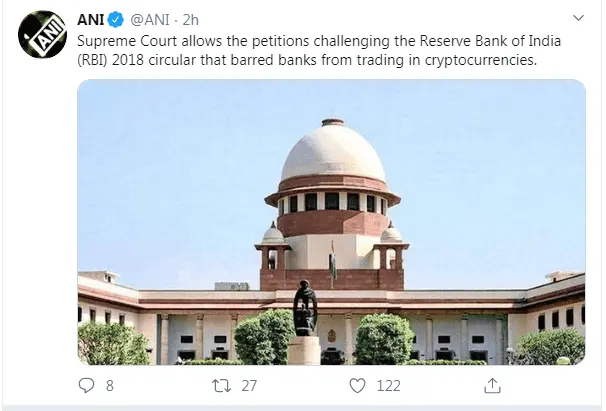
The single most common fear among Indian investors is that the government will ban crypto. The fear deserves a direct answer.
Crypto is legal in India. It has been since the Supreme Court struck down the RBI's banking ban in March 2020. Since then, the government has not moved to ban crypto — it has moved to tax and regulate it. The 2022 Union Budget introduced a dedicated tax framework for Virtual Digital Assets (VDAs) — a 30% flat tax on gains, and a 1% TDS on transactions under Section 194S.
That is not the behaviour of a government planning a ban. That is the behaviour of a government planning to regulate.
The regulatory trajectory is accelerating. India's Finance Ministry is in active talks with SEBI and RBI on a formal regulatory framework for crypto exchanges, as part of Budget 2026-27 planning. The COINS Act 2025 discussion paper proposed a structured licensing framework — not prohibition. The direction mirrors what Japan and Singapore have already built: licensed exchanges, taxed gains, and integration into the existing financial regulatory architecture.
Globally, the picture is clearer still. In January 2026, Morgan Stanley filed for Bitcoin, Solana, and Ethereum ETFs with the SEC — becoming the first major US bank to formally enter the crypto ETF market. This was not a speculative startup. This was a $1.4 trillion asset manager deciding that crypto belongs in its product lineup alongside equities, bonds, and real estate.
BlackRock's Bitcoin ETF (IBIT) now manages over $75 billion in assets. Bitcoin ETFs have attracted nearly $58 billion in total net inflows since January 2024. Goldman Sachs has said publicly that regulatory reform is the single biggest catalyst for institutional adoption — and that 71% of institutional investors plan to increase their crypto exposure over the next 12 months.

86% of institutional investors globally now have digital asset exposure or plan to allocate. When Morgan Stanley, BlackRock, and Goldman Sachs are building the infrastructure, the regulatory direction is no longer in doubt. This is not a fringe asset class operating in a grey area. It is an asset class being absorbed into mainstream finance.
Dimension 2: Strategy Safety
Whether crypto is safe depends heavily on how it is bought. Not all crypto investing carries the same risk. This is the dimension most discussions of crypto safety miss entirely.
Risk Dimension | Self-Directed Spot Trading | Managed Derivatives Portfolio |
Market exposure | Fully exposed to price swings | Hedged through options and futures |
Downside protection | None — portfolio drops with market | Built-in through options strategies |
Emotional decision-making | High — every swing triggers reactions | Removed — strategy runs independently |
Tax efficiency | Flat 30% under Section 115BBH | Slab rates under Section 43(5) |
Professional oversight | None | Active management with dynamic risk parameters |
Diversification | Only if built by the investor | Built into the basket strategy |
The difference between these two approaches is not incremental. It is structural. A managed portfolio that uses options, futures, and a debt fund allocation is built to generate consistent returns across market conditions — rising, falling, or sideways. A spot portfolio follows the market, wherever it goes.
Asking "is crypto safe" without specifying the strategy is meaningless. The strategy is the safety.
Dimension 3: Tax Safety
The existence of a clear, codified tax framework is itself a signal of maturity. India has one.
Spot crypto gains are taxed at a flat 30% under Section 115BBH. Crypto derivatives income is taxed as speculative business income at slab rates under Section 43(5) and Section 73. There is a 1% TDS on transactions under Section 194S. These are not ambiguous guidelines — they are law.
Opinions on whether the 30% rate is fair vary — most investors find it steep. The framework itself is clear: it defines exactly how gains will be treated. That is more than can be said for many countries that still lack any crypto tax guidance at all.
Tax treatment depends on individual circumstances and the prevailing interpretation of tax laws. Investors are advised to consult a qualified tax professional.
Dimension 4: Platform Safety
Platform matters as much as asset class. A strong crypto investment on a weak platform is still a risky proposition.
What to evaluate:
KYC process. A proper KYC verification indicates the platform is operating within regulatory norms. Platforms that skip KYC are cutting them.
Custody and security. Where the assets are held, what security certifications the custody provider holds, and whether insurance coverage exists.
Daily NAV transparency. The investor should be able to see what the investment is worth on any given day. A platform without daily NAV is asking the investor to operate without a scorecard.
Fee structure. Fees should be understood before commitment. Some platforms charge zero management fees currently — confirm what is planned for later.
Advisory support. For first-time crypto investors, access to advisors who can walk through the process removes most of the friction.
Compliance status. Whether the platform is registered, operating under applicable regulations, and tracking and reporting transactions as required.
Grade Capital operates a managed portfolio with daily NAV tracking, professional management, and advisory support — addressing the checklist above.
Dimension 5: Personal Fit
Even if crypto passes the first four tests with a confident yes, it still needs to fit the investor's personal financial situation. This is the most honest dimension — and the one most articles skip.
Allocation. A commonly recommended allocation is 5–10% of the overall portfolio. At that level, a sharp crypto decline does not materially damage the total financial position. Crypto is not unsafe at 5%. It becomes risky at 50%.
Horizon. Crypto works best as a medium-to-long-term investment. Capital needed within six months does not belong in crypto, managed or otherwise.
Affordability. Capital that cannot be committed should not be committed. When the answer to "can I afford to lock this in" is no, the issue is not crypto safety — it is allocation discipline.
Understanding. Not of blockchain technology — of the product itself: how it works, how it is taxed, what the minimum commitment period is, and how to exit.
What Actually Makes Crypto Riskier Than It Needs to Be
The question "is crypto safe" often gets a negative answer. The risks are real — but in specific contexts, and mostly self-inflicted. What makes crypto dangerous in practice, and what the safer alternative looks like:
Risky Behaviour | Why It Is Risky | Safer Alternative |
Picking single coins without research | Concentration risk — one bad coin sinks the portfolio | Diversified basket with professional selection |
Trading on leverage | Amplifies losses as much as gains — can wipe out capital | Managed portfolio with defined risk parameters |
Chasing meme coins | Driven by hype, not fundamentals — extreme volatility | Strategy-based investing with hedging |
Using unregulated platforms | No recourse, no compliance, no KYC | Regulated, KYC-compliant platforms with proper custody |
Investing without understanding tax | Unexpected 30% tax bill on gains — no planning for it | A full reading of the tax framework before commitment |
The pattern is consistent. The asset class is not the problem. The behaviour is. Every risk in the left column has a structural solution in the right column.
A Calmer Way to Think About Crypto in 2026
The crypto market of 2026 is not the crypto market of 2017. The landscape has changed in fundamental ways.
Institutional adoption has crossed a tipping point. When Morgan Stanley, BlackRock, Fidelity, and Goldman Sachs are building crypto products, the legitimacy question is answered. These are strategic business decisions backed by billions in capital commitment — not speculative bets.
Tax and regulatory frameworks exist. India taxes crypto, tracks transactions, and requires KYC. The scaffolding is in place, and the Finance Ministry is now working with SEBI and RBI on a more comprehensive version.
Professional management options exist. The investor no longer needs to trade crypto personally. Managed portfolios with hedging, daily NAV, and advisory support are operational. The entry point for a disciplined crypto investor has never been more accessible.
The real risk in 2026 is not investing in crypto. It is ignoring it without understanding it. That too is a decision — and it comes with a cost, measured in missed exposure to one of the fastest-growing asset classes of the last decade.
The Bottom Line
Whether crypto is safe in India in 2026 depends on how it is bought, through what platform, with what strategy, at what allocation, and within what tax framework. The five-dimension framework above provides the tools to answer the question independently.
The institutional world has already answered it. Morgan Stanley, BlackRock, and Goldman Sachs are not debating whether crypto is safe — they are building infrastructure to serve it at scale. The question for Indian investors is no longer whether to participate. It is how to participate responsibly.
The framework, the tables, and the checklists are above. They are the tools for a decision that fits the investor's financial reality.
Grade Capital publishes its managed crypto portfolio structure and NAV methodology at grade.capital.
This content is for informational and educational purposes only and does not constitute financial advice or an offer to invest.