In 2020, suggesting that pension funds should hold Bitcoin would have ended a career. In 2026, the Teacher Retirement System of Texas has allocated $400 million to crypto — the largest single pension fund commitment to digital assets. Abu Dhabi's Mubadala sovereign wealth fund holds $566 million in BlackRock's Bitcoin ETF. A Japanese national pension fund is allocating 1% of its corpus to crypto as a dollar hedge. Norway's Government Pension Fund has increased its indirect Bitcoin exposure by 149% year-on-year.
India, meanwhile, has 119 million crypto owners — more than the United States and China — processed $2.36 trillion in crypto transactions in 2024–25 (a 69% year-on-year increase), and ranks #1 on the Chainalysis Global Crypto Adoption Index for the third consecutive year.
Digital assets are no longer alternative investments. They are becoming the infrastructure of modern finance. Here is the data that proves it.
1. The Institutional Stampede
When BlackRock, Fidelity, and Sovereign Wealth Funds Move, It's Not Speculation — It's Strategy
The EY-Parthenon and Coinbase 2026 Institutional Investor Survey — polling 351 institutional decision-makers across asset managers, pension funds, family offices, and hedge funds — delivers a definitive verdict: 73% plan to increase their digital asset allocations in 2026. This is not marginal interest. Nearly three-quarters of the world's most sophisticated investors — fiduciaries managing trillions in assets — are actively increasing their crypto exposure.
The conviction runs deeper than allocation plans. 74% expect crypto prices to rise over the next 12 months. And 81% now prefer regulated investment products over direct exchange holdings — a structural shift from the era of institutional investors tentatively experimenting with crypto through side pockets and special-purpose vehicles. ETF and ETP usage rose to 66%, up from 47% in 2024. These institutions are not speculating — they are building permanent crypto operating models within their existing portfolio frameworks, favouring governance, compliance, security, and robust custody over cost.
The numbers in the Bitcoin ETF market make the case even more clearly. US spot Bitcoin ETFs now hold $128 billion+ in assets under management, with $58.72 billion in cumulative net inflows since their launch in January 2024. To put this in context: it took gold ETFs five years to reach $50 billion in AUM after launch. Bitcoin ETFs crossed that threshold in under one year.
BlackRock's IBIT alone holds approximately $67 billion — reaching $50 billion in AUM faster than any ETF in history. Fidelity's FBTC holds approximately $17 billion. Together, just these two products manage more than the GDP of most countries. These are not speculative trading vehicles. They are institutional-grade products issued by the world's largest and most regulated asset managers, held by pension funds, endowments, family offices, and registered investment advisors.
The pension fund allocations are particularly telling:
• Teacher Retirement System of Texas: $400 million — the largest single pension fund crypto commitment globally
• Abu Dhabi's Mubadala: 14.7 million IBIT shares worth approximately $566 million (as of March 2026), making BlackRock's Bitcoin ETF their second-largest 13F-reportable holding
• Japan's National Business Corporate Pension Fund: allocating approximately 1% of corpus to crypto from FY2026 as a hedge against dollar depreciation
• Norway's Government Pension Fund Global: indirect exposure of 9,573 BTC — a 149% increase year-on-year — through holdings in public crypto companies
These are the most risk-conscious capital allocators on the planet, organisations with fiduciary obligations to retirees, beneficiaries, and long-term savers. They do not chase momentum. They do not follow social media narratives. They allocate to asset classes after years of due diligence, stress testing, and board-level approval. When pension funds managing the retirement savings of millions of teachers begin allocating to crypto, the question is no longer whether digital assets belong in a portfolio — it is whether you are positioned for the shift.
"Tokenization is the next wave of opportunity for financial markets. Every asset — every stock, every bond, every fund — can be tokenized."
— Larry Fink, CEO of BlackRock (2026 Annual Letter)
BlackRock is not just talking about tokenization — it is building it. The firm's BUIDL tokenized fund holds $2.8 billion, and Fink has called the era of "tokenization of all assets" a fundamental transformation comparable to the shift from floor trading to electronic markets.
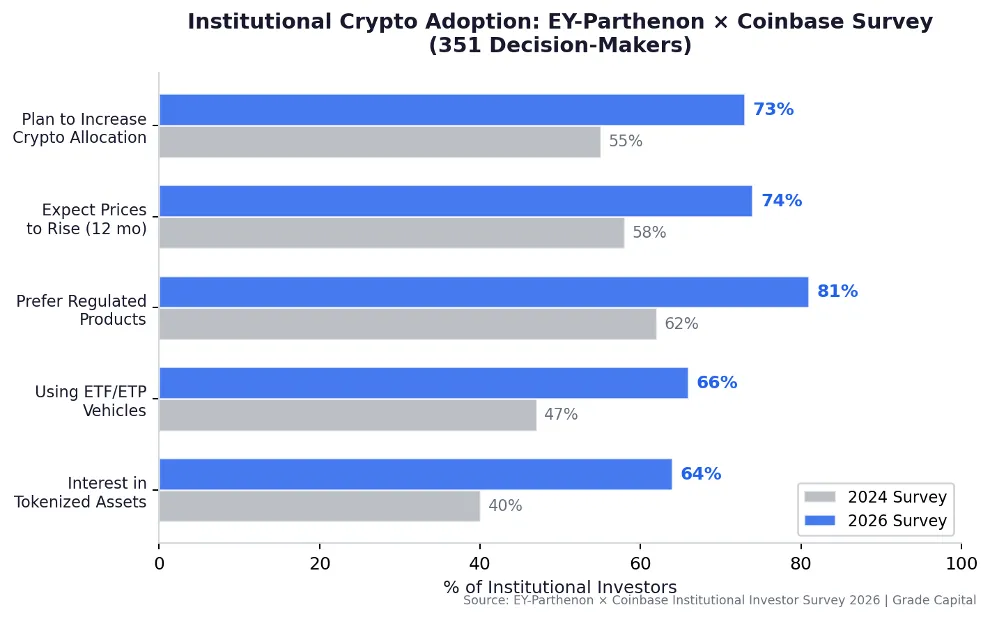
Figure 1: Institutional Crypto Adoption — EY-Parthenon × Coinbase Survey 2026 (351 Decision-Makers)
Institution | Vehicle | Allocation / AUM | Year |
BlackRock (IBIT) | Spot Bitcoin ETF | ~$67B AUM | 2024–26 |
Fidelity (FBTC) | Spot Bitcoin ETF | ~$17B AUM | 2024–26 |
Texas Teachers Pension | Direct Allocation | $400M | 2025–26 |
Mubadala (Abu Dhabi) | IBIT Shares | $566M (14.7M shares) | March 2026 |
Japan Corporate Pension | Multi-Asset | ~1% of Corpus | FY2026 |
Norway Govt Pension | Indirect (Equity) | 9,573 BTC exposure | 2025 (+149% YoY) |
All US Spot BTC ETFs | ETF / ETP | $128B+ AUM total | Jan 2024–present |
Table 1: Major Institutional Crypto Allocations (Sources: BlackRock, SEC 13F, KuCoin, The Block)
2. The Infrastructure Revolution — Stablecoins, Tokenization, and the New Financial Plumbing
Crypto Isn't Just an Asset Class — It's Becoming the Rails That Money Moves On
Most people still think of crypto as an investment — something you buy, hold, and hope goes up. That framing misses the structural transformation happening underneath. Crypto is becoming the plumbing of global finance — the infrastructure through which money, assets, and value actually move.
Consider stablecoins. Stablecoins — digital currencies pegged to fiat currencies like the US dollar — are not volatile speculative assets. They are payment rails. In 2025, stablecoins processed $33 trillion in transactions, surpassing Visa and Mastercard's combined $25.5 trillion. Adjusted volume hit a record $1.79 trillion in June 2026 alone — up 125% year-on-year. Analysts project stablecoin volume will exceed $50 trillion for full-year 2026.
The institutional validation of stablecoins is unmistakable. Circle, the issuer of USDC, listed on the NYSE in 2025 and gained MiCA compliance in the European Union — making USDC the first major stablecoin with regulatory approval across both US and EU markets. USDC now accounts for approximately 70% of adjusted stablecoin volume in the first half of 2026. Visa has settled approximately $3.5 billion annualized in USDC — the world's largest payment network is already using crypto rails for cross-border settlement.
In March 2026, Mastercard acquired stablecoin infrastructure firm BVNK for up to $1.8 billion — its largest acquisition and clearest bet on the mainstreaming of digital currencies. Corporates settled an estimated $2.4 trillion in B2B stablecoin payments during 2025, with the figure expected to double in 2026. Around 90% of financial institutions are now using or piloting stablecoins for some form of treasury or settlement operation.
Then there is tokenization — the process of representing real-world assets (stocks, bonds, real estate, funds) as digital tokens on a blockchain. Tokenization enables fractional ownership, instant settlement, 24/7 trading, and automated compliance — capabilities that traditional market infrastructure cannot match. The global asset tokenization market is valued at $2 trillion+ in 2025, projected to exceed $13 trillion by 2030 according to Mordor Intelligence. Tokenized real-world assets have surpassed $26.71 billion in distributed value. And asset managers' interest in tokenizing their funds jumped from 40% to 64% in just one year, per the EY-Parthenon survey.
The BCG report "The Future of Digital Assets in Finance" (2026) positions digital assets not as an alternative asset class but as a transformation of payments, market infrastructure, and global commerce. The report argues that digital assets are integrating into three layers simultaneously: retail and institutional payments (stablecoins), capital markets infrastructure (tokenization), and cross-border commerce (programmable money). This is not a parallel financial system — it is the upgrade to the existing one.
For Indian investors, the infrastructure revolution has a specific implication: the financial products of the next decade — tokenized mutual funds, on-chain bonds, programmable fixed deposits — will be built on crypto infrastructure. Understanding digital assets today is not about speculative trading. It is about understanding the architecture of tomorrow's financial system.
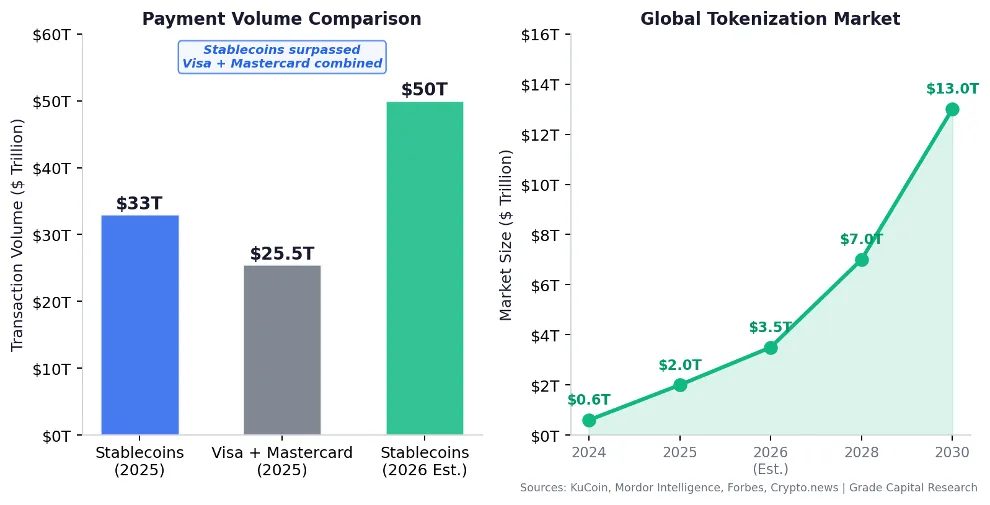
Figure 2: Stablecoin Volume vs Visa/Mastercard (2025) and Global Tokenization Market Projections
3. India's Unique Position — Why This Matters More Here Than Anywhere
India Isn't Just Adopting Crypto — India Is Leading the Global Crypto Revolution
India ranks #1 on the Chainalysis Global Crypto Adoption Index for the third consecutive year (2023, 2024, 2025), topping every sub-category including centralized exchange activity, DeFi participation, and peer-to-peer transfers. This is not a ranking that India narrowly holds — India tops it across every metric.
The numbers behind the ranking: 119 million crypto owners as of 2025, projected to reach 123–127 million in 2026 — more crypto users than the United States (55 million) and China (40 million) individually. Penetration sits at approximately 8.35% of the population. Critically, 72% of India's crypto investors are under 35, and Gen Z (18–25) now represents 38% of the market. This is not a passing trend — it is a generational shift in how young Indians think about wealth building.
India processed $2.36 trillion in crypto transactions between July 2024 and June 2025 — a 69% year-on-year increase — making it one of the primary drivers of the Asia-Pacific region's crypto growth. The Indian cryptocurrency market reached $3.04 billion in 2025, with revenue projected at $9.1 billion in 2026 and the market expected to reach $14.21 billion by 2034 (an 18.66% CAGR), according to IMARC Group and Statista.
What makes India's adoption remarkable is that it has occurred despite one of the world's harshest crypto tax regimes: a 30% flat tax on virtual digital asset (VDA) gains under Section 115BBH, plus 1% TDS on transactions exceeding ₹50,000 (₹10,000 for specified persons) under Section 194S. No loss set-off. No indexation benefit. Yet Indians continue investing at record rates — signalling deep structural demand rather than speculative froth.
The regulatory framework is hardening in a constructive direction. SEBI is emerging as the primary crypto regulator in ongoing discussions with the Finance Ministry and RBI, moving toward a comprehensive regulatory framework that would bring crypto under securities law rather than treating it as an unregulated grey area. 47 exchanges are registered with FIU-IND and operating within the legal framework. India's $9.1 billion projected crypto revenue for 2026 makes it too significant for the government to ignore — the trajectory is toward regulation, not prohibition.
As institutional-grade products become more important, the gap between India's massive user base and the absence of managed investment products becomes the defining opportunity. 119 million users are investing through exchanges with no professional guidance, no portfolio construction, and no risk management. In the United States, Bitcoin ETFs alone provide $128 billion+ in professionally managed access. India has no equivalent — yet.
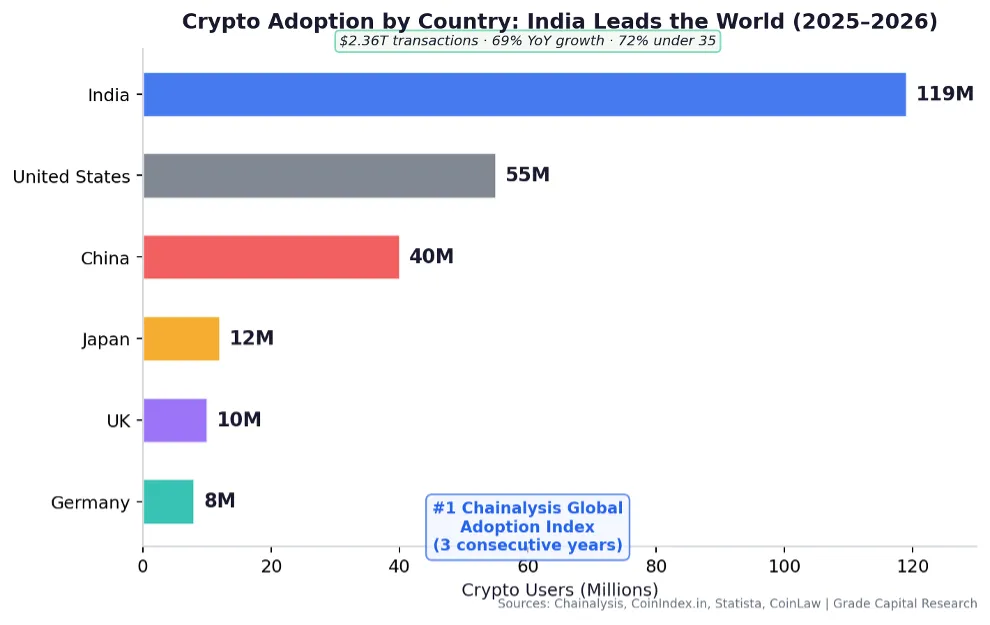
Figure 3: Crypto Adoption by Country — India Leads with 119M Users (Sources: Chainalysis, CoinIndex.in)
Metric | India | United States | Global |
Crypto Users | 119M (2025) | 55M | ~580M |
Chainalysis Ranking | #1 (3 consecutive years) | #2 | — |
Transaction Volume (2024-25) | $2.36 trillion | ~$4.1 trillion | ~$14 trillion |
YoY Growth | 69% | 22% | 34% |
Population Penetration | 8.35% | 16.5% | 7.3% |
Median Investor Age | 72% under 35 | 42% under 35 | 55% under 35 |
Tax on Gains | 30% flat (VDA) | 0–37% (capital gains) | Varies |
Bitcoin ETF AUM | Not available | $128B+ | $130B+ |
Managed Crypto Products | Minimal | $128B+ (ETFs alone) | Growing |
Table 2: India vs US vs Global — Crypto Adoption Metrics (Sources: Chainalysis, Statista, CoinIndex.in, CoinLaw)
4. The Portfolio Argument — Why Digital Assets Belong in Every Investor's Strategy
The Math Behind Adding 5–15% Crypto to a Traditional Indian Portfolio
The conversation around crypto has fundamentally shifted from "should I invest?" to "how much should I allocate?" When CNBC publishes a guide on how crypto fits into a diversified portfolio, when State Street Global Advisors publishes research calling digital assets "the next frontier for markets and investors," and when Schwab titles a report "From Niche to Normal: Crypto's Move to the Mainstream" — the debate about legitimacy is over.
The portfolio argument rests on modern portfolio theory: assets with low correlation to traditional holdings reduce overall portfolio volatility while potentially enhancing returns. An Indian investor's typical portfolio — fixed deposits (6.5–8.6% returns), Nifty 50 equities (~12% historical CAGR), gold (~15–20% in 2025, the best year since 1979 with 65% gains) — benefits from exposure to an asset class that behaves differently from all three.
The EY-Parthenon survey shows institutional exposure to digital assets has increased from approximately 5% to 9% of AUM, with projections reaching 18% within three years. These are not aggressive crypto funds — these are diversified institutional portfolios, managed by CIOs who answer to investment committees and boards of directors, that have nearly doubled their crypto weight as the asset class matured from speculative to structural.
Bitcoin's performance provides the context. BTC has traded in the $87,000–$110,000 range through 2025–2026, representing a maturation from the extreme volatility of earlier cycles. More importantly, Bitcoin ETFs attracted $58.72 billion in cumulative net inflows since launch — steady, sustained institutional demand rather than the boom-bust retail patterns of previous cycles.
For individual investors, a 5–15% allocation to digital assets — structured through managed products rather than direct exchange trading — aligns with the institutional consensus. A ₹50 lakh portfolio with a 10% crypto allocation (₹5 lakh) managed through a diversified basket is structurally different from putting ₹5 lakh into a single token on an exchange. The former is portfolio construction. The latter is concentration risk.
The key question is not whether to allocate, but how to allocate properly. And that question leads directly to the gap in India's market — a gap between what institutional investors globally have access to and what Indian retail investors are currently doing.
5. The "How" Problem — And Why Most Indians Get It Wrong
Buying Crypto on an Exchange Is Like Buying Stocks Without a Broker in 1990
Most of India's 119 million crypto users access digital assets through exchanges — buying individual tokens based on social media tips, YouTube analysis, or peer recommendations. This is the equivalent of picking individual stocks without professional guidance, diversification strategy, risk management, or rebalancing discipline. In traditional finance, this approach was abandoned decades ago in favour of mutual funds, portfolio management services, and wealth management.
The risks of exchange-only investing were demonstrated starkly when WazirX suffered a $234 million hack in July 2024, affecting 4.4 million Indian users and wiping out 45% of the platform's reserves. The Lazarus Group — a North Korea-linked threat actor — exploited a multi-signature wallet vulnerability. This was not a market risk or an investment loss. It was a custody failure — the kind of risk that managed investment products with institutional-grade custody are designed to eliminate.
The gap in India's market is stark: 119 million crypto users, but virtually zero managed crypto investment products. Compare this to the United States, where Bitcoin ETFs alone hold $128 billion+ in AUM — structured, regulated, professionally managed. In the US, an investor who wants exposure to Bitcoin can purchase an ETF through their existing brokerage account, with institutional custody, transparent pricing, and regulatory oversight. In India, the same investor must navigate exchange interfaces, manage their own private keys or trust exchange custody, and make individual trading decisions without professional guidance. Indian investors have the demand, but the infrastructure for professional crypto investing is still nascent.
The result is predictable. Indian investors treat crypto like gambling instead of investing. No asset allocation framework. No risk controls. No systematic rebalancing. No tax optimization beyond the blunt 30% flat rate. No custody protection against exchange failures. The investor who would never pick individual stocks without a mutual fund manager is making concentrated bets on individual tokens without any professional guidance.
In traditional finance, India solved this problem decades ago. The mutual fund industry grew from ₹7 lakh crore to ₹65+ lakh crore in AUM over the past decade precisely because it offered professional management, diversification, and systematic investment to retail investors. The crypto market in India needs the same evolution — from self-directed speculation to professionally managed, structured investment products.
6. What This Means for You — The Grade Capital Perspective
How Grade Capital Is Building the Bridge Between Traditional and Digital Investing
Grade Capital offers fully-managed crypto derivatives baskets — structured exposure to digital assets with professional portfolio management, institutional-grade custody (SOC 2 Type II), and a managed approach to risk. Think of it as what a mutual fund does for equities, but designed for the digital asset market.
The approach is built for Indian investors who recognise that digital assets belong in their portfolio but do not want to become full-time crypto traders. Grade Capital's managed baskets provide diversification across digital assets, systematic risk controls, and structured allocation — the same disciplines that made mutual funds and PMS the default for equity investing in India.
Grade Capital also have SIP (Systematic Investment Plan) functionality — bringing the discipline of systematic, periodic investing to digital assets. For a generation of Indian investors raised on equity SIPs, this represents the most familiar and disciplined entry point into digital asset allocation.
The thesis is straightforward: digital assets are the future of investing. The institutional data confirms it — 73% of institutional investors are increasing allocation. India's adoption leadership confirms it — 119 million users, #1 globally for three consecutive years. The infrastructure revolution in stablecoins and tokenization confirms it — $33 trillion in stablecoin volume, $2 trillion in tokenized assets. Grade Capital is how Indian investors can participate in this structural shift without becoming full-time crypto analysts — with professional management, institutional custody, and the discipline of structured investing.
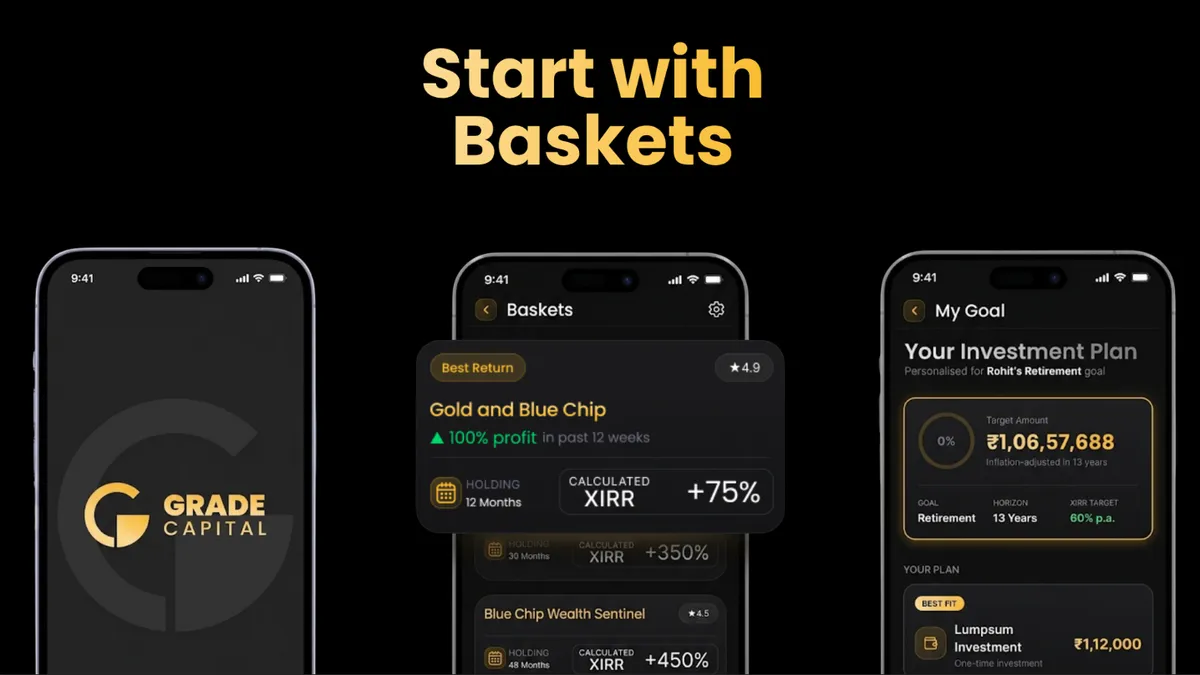
Grade Capital — Managed Crypto Derivative Baskets with Institutional Custody