What Traditional Crypto Investing Looks Like
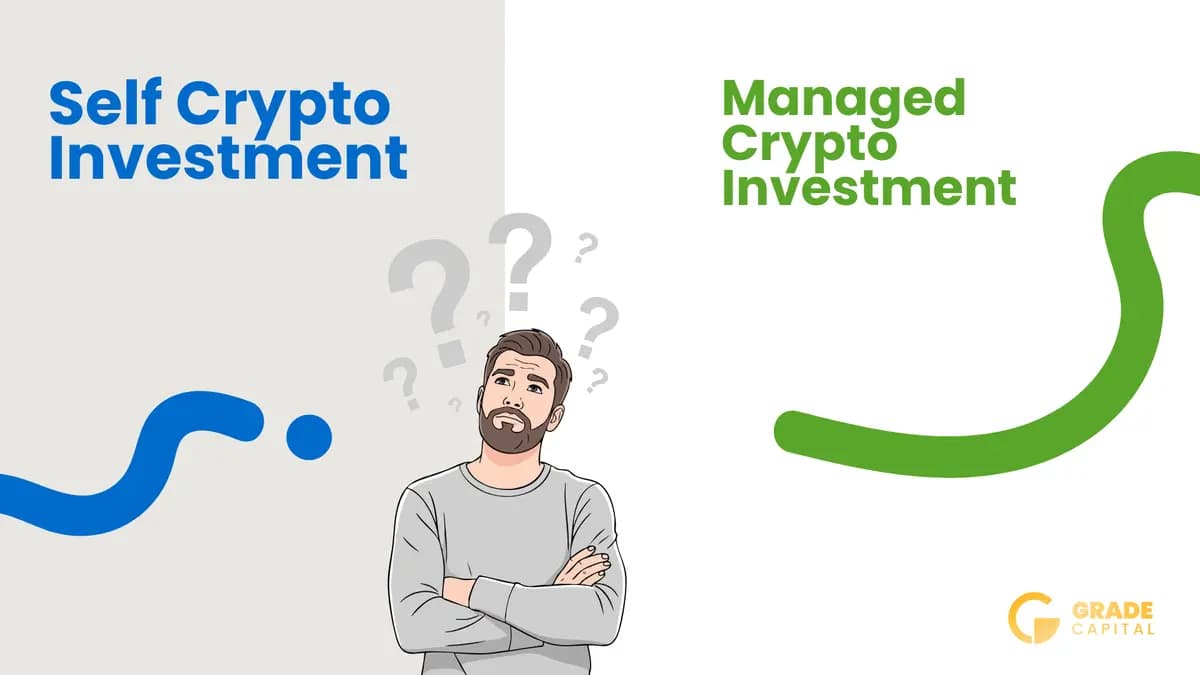
Most people enter crypto the same way. They sign up on an exchange, pick a few coins — usually Bitcoin and Ethereum — transfer money, and buy. The coins sit in a wallet. When prices go up, the portfolio rises. When prices fall, the portfolio falls with it.
This is spot crypto investing. You own the underlying asset directly. Your returns are entirely tied to the price movement of the coins you picked.
There is nothing inherently wrong with this approach. But it comes with a set of structural constraints that many investors do not fully consider before committing capital.
First, the tax burden. Under Section 115BBH of the Income Tax Act, any gains from selling Virtual Digital Assets (VDAs) — which includes all spot crypto — are taxed at a flat 30%. No deductions for expenses. No offsetting losses from one coin against gains from another. No carrying forward losses to future years. This is among the harshest crypto tax regimes globally.
Second, the risk is entirely on you. There is no professional rebalancing, no hedging, no options overlay to protect your downside. If the market drops 40%, your portfolio drops 40%.
Third, timing matters enormously. Self-directed investing requires you to decide when to buy, what to buy, and when to sell. Getting even one of those decisions wrong can significantly impact your outcome.
How Grade Capital's Approach Differs
Grade Capital operates on a fundamentally different model. Instead of buying and holding spot crypto, it runs a managed crypto derivatives fund — using futures and options contracts rather than owning coins directly.
This distinction matters more than most people realize.
Derivatives allow for hedging. When Grade Capital's strategy includes options positions alongside futures, the fund has a mechanism to generate returns even when the broader market declines. A spot portfolio cannot do this. It goes up only when prices go up.
Professional management replaces individual decision-making. The fund's strategy involves active position management, dynamic risk parameters that adjust to market conditions, and systematic rebalancing. You are not picking coins and hoping for the best.
The NAV is denominated in USDT (a USD-pegged stablecoin), calculated daily. This gives investors a familiar reference point — similar to how mutual fund investors track NAV — while also creating a dual-return structure. Because the fund's value is in USD while Indian investors enter and exit in INR, the natural depreciation of the rupee against the dollar adds an estimated 3-4% per annum on top of the fund's performance.
The Complete Side-by-Side Comparison
Here is how the two approaches compare across the dimensions that matter most:
Feature | Traditional Spot Crypto | Grade Capital |
|---|---|---|
Investment approach | Buy and hold individual coins | Managed derivatives (futures + options) |
Tax treatment | Flat 30% under Section 115BBH | Slab rates as speculative business income |
Loss offset | Not allowed | Losses can offset speculative gains |
Loss carry-forward | Not allowed | Up to 4 years |
Expense deductions | Not allowed | Business expenses deductible |
Risk management | Self-directed, no hedging | Professional hedging with options overlay |
Returns in falling markets | Portfolio declines with market | Designed to generate returns via options |
Minimum investment | Varies by platform (often ₹100) | ₹12,000 lumpsum |
Professional management | None — fully self-directed | Active management with dynamic risk parameters |
NAV tracking | No standardized NAV | Daily NAV in USDT |
Payment methods | Varies | UPI, IMPS, NEFT, Bank Transfer |
This is not a question of which is "better" in the abstract. It depends on what kind of investor you are, how much time you want to spend managing positions, and how much the tax structure matters to your net returns.
The Tax Difference: Why It Deserves Its Own Section
The tax gap between spot crypto and crypto derivatives is the single most underappreciated difference in Indian crypto investing. It deserves a careful look.
Parameter | Spot Crypto (VDAs) | Crypto Derivatives (Grade Capital) |
|---|---|---|
Applicable section | Section 115BBH | Section 43(5) and Section 73 |
Tax rate | Flat 30% on gains | Income tax at applicable slab rates |
Expense deductions | Not permitted | Business expenses can be deducted |
Loss offset | Not allowed against any income | Can offset against speculative gains |
Loss carry-forward | Not allowed | Carry forward for up to 4 years |
ITR form | ITR-2 (Capital Gains) | ITR-3 (Business Income) |
Here is what this means in plain terms. If you earn ₹10 lakh from selling spot crypto, you pay ₹3 lakh in tax — regardless of your income slab, regardless of any expenses you incurred, and regardless of whether you lost ₹5 lakh on another coin the same year.
With crypto derivatives classified as speculative business income, the same ₹10 lakh gain would be taxed at your applicable slab rate. If you are in the 20% bracket, you pay ₹2 lakh. You can deduct legitimate business expenses. And if you had losses on another speculative position, you can offset them — and carry forward any remaining losses for four years.
For investors dealing with meaningful capital, this structural difference compounds significantly over time.
Tax treatment depends on individual circumstances and the prevailing interpretation of tax laws. Investors are advised to consult with qualified tax professionals to understand how these provisions apply to their specific situation.
Grade Capital Performance: What the Numbers Show
The fund has been live since January 1, 2023 — starting with an inception NAV of $10.00 USDT. As of February 10, 2026, the NAV stands at $130.80 USDT. That is a track record of 1,081 days — approximately 3.11 years of actual live performance, not a backtest.
Here is what the key metrics look like:
Metric | Value |
|---|---|
Absolute Return | 1,208% |
CAGR | 128.57% |
Sharpe Ratio | 1.41 |
Sortino Ratio | 1.75 |
All-Time Highs Recorded | 131 |
A few things worth noting about these numbers.
The Sharpe Ratio of 1.41 tells you that for every unit of risk the fund takes, it generates meaningful excess return above the risk-free rate. A Sharpe above 1.0 is generally considered strong. The fund sits comfortably above that threshold.
The Sortino Ratio of 1.75 is arguably more telling. Unlike the Sharpe Ratio, which penalizes all volatility equally, the Sortino Ratio only penalizes downside volatility. A higher Sortino suggests that most of the fund's price movement comes from gains rather than losses. For an investor, this is precisely the kind of volatility profile you want.
131 all-time highs in 1,081 days means the fund has set a new peak roughly once every 8 days, on average. That is a reflection of consistent upward progression rather than a single large spike.
The year-by-year breakdown shows the fund delivering across different market conditions:
2023: +215.17%
2024: +89.43%
2025: +81.52%
2026 YTD: +6.24%
The returns are not uniform — nor should you expect them to be. But the consistency of positive annual performance across three full calendar years, each with different market dynamics, is part of the picture.
Past performance is not indicative of future results. The returns presented are historical and may not be repeated.
How Managed Crypto Investing Actually Works at Grade Capital
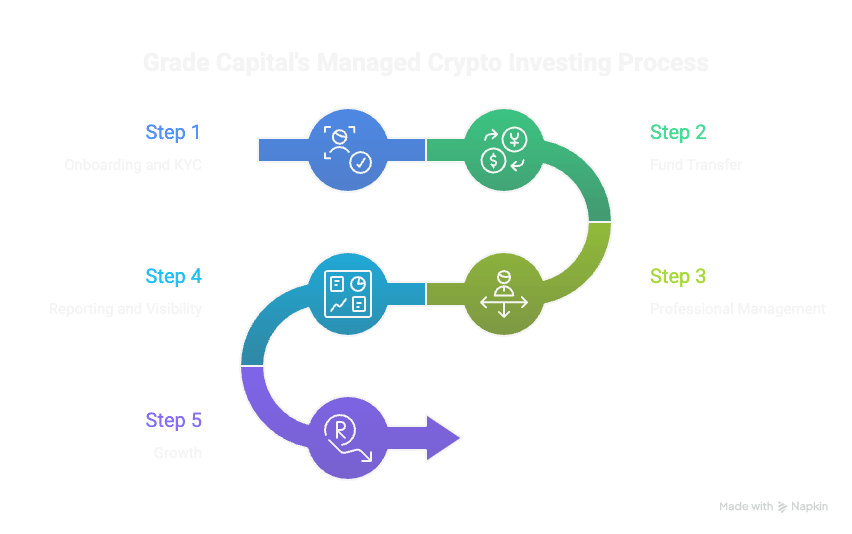
If the comparison above sounds compelling in theory, here is how it works in practice. The investment process at Grade Capital follows five steps:
Step 1: Onboarding and KYC. Verification completes in under 30 seconds. The app is available on both Android (Google Play) and iOS (App Store).
Step 2: Fund Transfer. You transfer INR via UPI, IMPS, NEFT, or bank transfer. The amount is converted to USDT and allocated to the managed fund.
Step 3: Professional Management. This is where the core value lies. The fund runs active derivatives strategies — futures and options — with dynamic risk parameters that adjust based on market conditions. Positions are hedged. The portfolio is rebalanced. You do not need to monitor charts or make trading decisions.
Step 4: Reporting and Visibility. You get real-time portfolio visibility through the app or web dashboard. NAV is calculated daily in USDT.
Step 5: Redemption. When you choose to exit, the process converts USD to INR at prevailing rates and deposits to your bank account.
The lock-in period varies by basket, typically ranging from 6 to 12 months. Currently, Grade Capital charges zero management fees — though a 1% annual management fee is planned.
What Grade Capital Does Not Do
Clarity also means being transparent about what this model is not.
Grade Capital is not a crypto exchange. You are not buying or selling individual coins. You do not get to pick which tokens to hold. If you want the experience of selecting specific cryptocurrencies and managing a personal portfolio, this is not that.
It is not a passive basket product. Several platforms in India offer "crypto baskets" or "crypto packs" where you buy a bundle of spot coins and hold them. Grade Capital's approach is fundamentally different — it uses derivatives with active management and hedging, not passive spot holdings.
Who Should Consider Each Approach
Traditional spot crypto may suit you if:
You want direct ownership of specific cryptocurrencies
You enjoy active trading and market analysis
You are investing small amounts and the 30% tax is not a major concern at your scale
You want full control over which coins you hold and when you sell
Grade Capital may suit you if:
You prefer professional management over self-directed trading
Tax efficiency matters to your investment strategy
You want exposure to crypto returns without the daily involvement of managing positions
You are comfortable with a minimum investment of ₹12,000 and a lock-in period
You want a strategy designed to navigate both rising and falling markets
Neither approach is universally correct. The right choice depends on your capital, your tax situation, your risk appetite, and how involved you want to be.
The Bottom Line
The gap between traditional spot crypto investing and a managed derivatives approach is not a matter of degree. It is a structural difference — in how gains are taxed, how risk is managed, how returns are generated in different market conditions, and how much of the decision-making burden falls on you.
Grade Capital represents a specific answer to a specific set of problems: the 30% VDA tax, the absence of professional management in most Indian crypto products, and the one-directional risk of spot holdings. Whether that answer fits your situation depends on what you are optimizing for.
The numbers, the tax framework, and the comparison tables are all above. Take the time to work through them.
Explore how Grade Capital's managed crypto derivatives approach works at grade.capital.
This content is for informational and educational purposes only and does not constitute financial advice or an offer to invest.