How to invest in crypto India 2026 is a question that 119 million Indians have already answered — but most have used only one of three available methods, and it is usually the one with the highest tax rate. India ranks #1 globally in crypto adoption according to the Chainalysis 2024 Global Crypto Adoption Index, with the user base projected to reach 123.35 million by end of 2026. Yet the vast majority of these investors simply buy Bitcoin on an exchange and hold — paying a flat 30% tax on every rupee of profit.
There are actually two distinct methods to invest in crypto from India, each with materially different tax rates, risk profiles, and access requirements. This article compares all three — direct exchange trading, Bitcoin ETFs via LRS, and managed crypto funds — so you can make an informed decision based on data, not habit.
Method 1: Direct Trading on Crypto Exchanges (Spot and Derivatives)
This is the most common method and the one most Indian investors default to. You create an account on a crypto exchange, complete KYC, deposit INR, and trade directly — buying and selling crypto assets in real time.
How It Works
Spot trading means buying actual cryptocurrency (BTC, ETH, SOL, etc.) and holding it in your exchange wallet. You profit only when prices go up. Derivatives trading means trading futures and options contracts on crypto — you can profit in both rising and falling markets without owning the underlying asset. This distinction matters enormously for taxation.

Source: Binance — Global crypto exchange with 320+ million registered users. Exchanges provide direct access to spot and derivatives trading across hundreds of crypto assets.
Key Platforms in India (2026)
Several FIU-IND registered exchanges operate in India. CoinDCX is widely considered the most comprehensive India-first platform with strong regulatory compliance. CoinSwitch has 20+ million registered users and is popular for its beginner-friendly interface. Mudrex serves 3 million users with Rs 500 crore in AUM, and recently launched INR-margined crypto futures. ZebPay, one of the oldest Indian exchanges, remains a conservative choice with high security standards.
A cautionary note: WazirX was hacked for $230 million in July 2024, resulting in a 16-month trading shutdown. As of early 2026, users received approximately 85% of their portfolio value back, with the remaining 15% issued as Recovery Tokens. The incident underscores a fundamental risk of exchange-held crypto: there is no DICGC-equivalent deposit insurance. If an exchange is compromised, your assets are at risk.
Tax Treatment: The 30% Problem (and the Derivatives Escape)
This is where most Indian crypto investors lose the most money — not to the market, but to taxes.
Spot trading: All gains are taxed at a flat 30% under Section 115BBH, regardless of holding period. No deductions allowed (not even transaction fees). No loss offset — if you lose Rs 5 lakh on one trade and gain Rs 5 lakh on another, you pay 30% tax on the gain and cannot deduct the loss. No carry-forward of losses. An additional 1% TDS applies on every transaction under Section 194S.
Derivatives trading: Since crypto exchanges are not recognised stock exchanges under the Securities Contracts Regulation Act (SCRA), crypto futures and options are classified as speculative business income under Section 43(5). This means they are taxed at your income slab rate — not the flat 30%. Business expenses (brokerage, advisory fees, internet, depreciation) can be deducted. Losses can offset other speculative income and carry forward for four years.
Parameter | Spot Crypto (Section 115BBH) | Crypto Derivatives (Section 43(5)) |
Tax Rate | 30% flat (+ 4% cess) | Income slab rate (0-30%) |
Expense Deduction | Not allowed | Allowed (business expenses) |
Loss Offset | Not allowed | Against other speculative income |
Loss Carry-Forward | Not allowed | 4 years |
TDS | 1% on every transfer (Sec 194S) | None |
ITR Form | ITR-2 (Capital Gains) | ITR-3 (Business Income) |
Effective Tax (Rs 5L gain, 20% slab) | Rs 1,56,000 (31.2%) | Rs 1,04,000 (20.8%) |
Risks of Direct Exchange Trading
Beyond taxation, exchange trading carries several risks that investors should weigh. Exchange security risk (WazirX hack: $230 million lost), emotional trading (buying high during FOMO, selling low during panic), no professional risk management (no hedging, no stop-losses unless self-managed), and self-custody risk with no DICGC-type insurance protection. For the 72% of Indian crypto investors who are under 35, the temptation to trade actively rather than invest systematically compounds these risks.
Method 2: Managed Crypto Funds and Indices in India
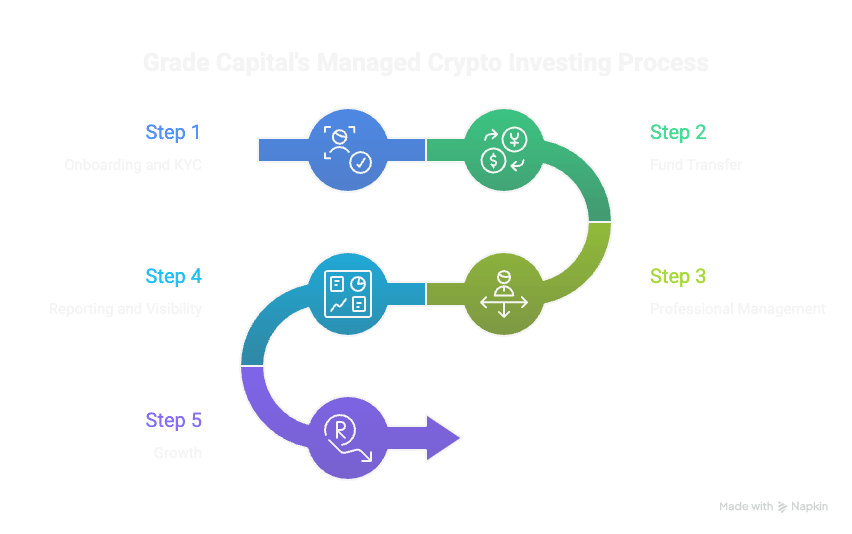
The second method is the newest and, for many investors, the most overlooked. Several platforms now offer professionally managed crypto exposure — where you invest INR and a fund manager or algorithm handles the trading, hedging, and rebalancing. Think of it as the mutual fund model applied to crypto.
Grade Capital — Managed Crypto Derivatives Fund
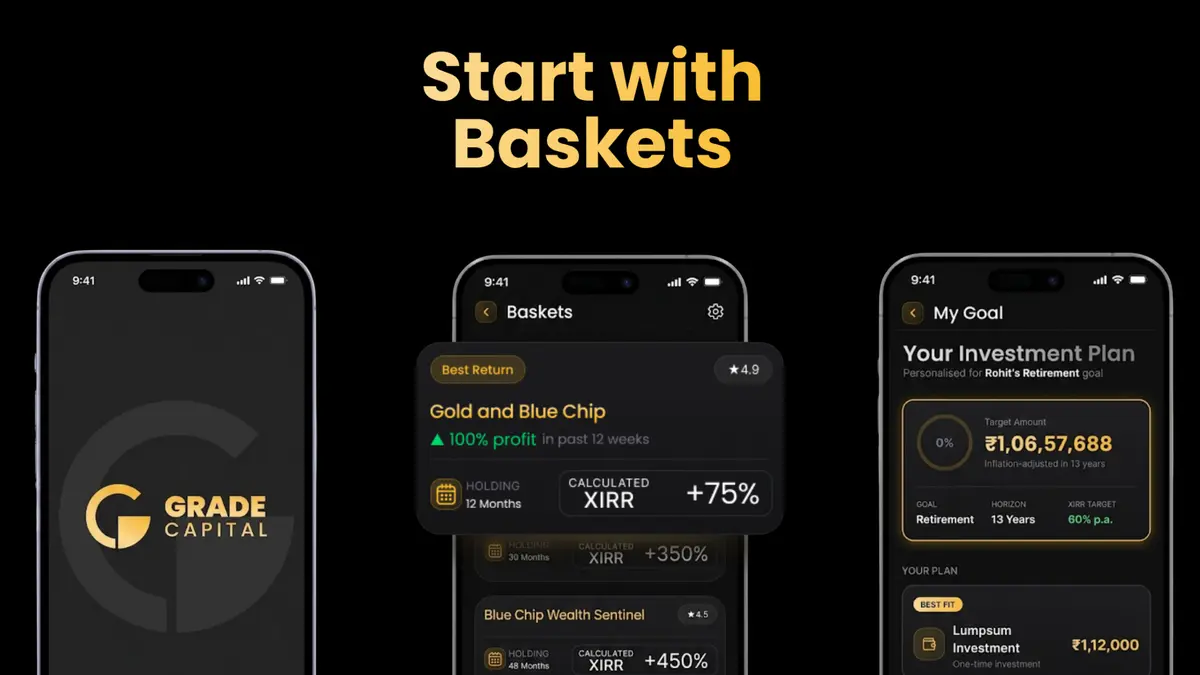
Grade Capital is India's first professionally managed crypto derivatives fund. Unlike exchange spot trading or passive index tracking, Grade Capital actively manages a portfolio of crypto futures and options — deploying hedging strategies that can generate returns even when the market falls.
Since inception in January 2023, the fund has delivered an absolute return of 1,090.20% with a CAGR of 133.83%. More importantly, its Sharpe ratio of 1.71 is 78% higher than Bitcoin's 0.96 — meaning it delivers materially better returns per unit of risk. The fund has posted positive returns in 25 of 36 months (69.4%), with custody secured through Fireblocks (SOC 2 Type II, ISO 27001 certified). Minimum investment starts at Rs 12,000, and the fund is FIU-IND compliant via OnMeta.
The tax structure is the key differentiator: because Grade Capital trades derivatives — classified under Section 43(5) as speculative business income — investors pay tax at their income slab rate, not the flat 30% VDA tax. This combines professional risk management with the best available tax treatment for crypto in India.
BitSave — Bloomberg Galaxy Crypto Index Fund
BitSave offers a passive approach — it is the only licensed provider of the Bloomberg Galaxy Crypto Index (BGCI) in India. The BGCI tracks the 11 largest cryptocurrencies by market capitalisation: BTC, ETH, XRP, SOL, ADA, LINK, SUI, BCH, LTC, AVAX, and XLM. Think of it as a Nifty 50 for crypto — you buy one unit and get exposure to the entire blue-chip crypto market.
Minimum investment is just $50 (approximately Rs 4,500) with no lock-in period. Exit load is 1% if redeemed within 30 days and zero after that. BitSave secured pre-Series A funding from Leo Capital and offers features including UPI deposits, regulated custody, and proof-of-reserves transparency. As a spot-based product, gains are subject to the 30% VDA tax under Section 115BBH.
Mudrex — Thematic Crypto Baskets (Coin Sets)
Mudrex takes a thematic approach with its Coin Sets — curated baskets grouped by themes like DeFi, Web3, Smart Contracts, and major-cap crypto. With 3 million users and Rs 500 crore in AUM, Mudrex is the largest platform in this category. It is fully FIU-IND registered with automatic 1% TDS deduction, DigiLocker KYC, and UPI support.
Mudrex also offers SIP (systematic investment plan) functionality for auto-investing at regular intervals, and custom basket creation where you choose your own tokens and allocations. Like BitSave, Mudrex's Coin Sets are spot-based and subject to the 30% VDA tax. In 2026, Mudrex expanded into INR-margined crypto futures, though this feature targets active traders rather than passive investors.
Head-to-Head Comparison: Which Method Is Right for You?
Parameter | Exchange (Spot) | Exchange (Derivatives) | Managed Fund (Grade Capital) | Index Fund (BitSave) |
Tax Rate | 30% flat | Slab rate | Slab rate | 30% flat |
Loss Offset | No | Yes (speculative) | Yes (speculative) | No |
Min Investment | Rs 100 | Rs 100 | Rs 12,000 | $50 (~Rs 4,500) |
Risk Management | Self-managed | Self-managed | Professional (hedging) | None (passive index) |
Currency | INR | INR/USD | INR | USD |
Custody | Exchange wallet | Exchange wallet | Fireblocks | Liminal |
Upside in Bear Market | No | Yes (short positions) | Yes (options hedging) | No |
Regulatory Status | FIU-IND registered | FIU-IND registered | FIU-IND compliant | FIU-IND compliant |
The Number Most Investors Never Calculate
Here is a calculation that changes how most people think about crypto investing in India.
Assume you invest Rs 10 lakh and earn Rs 5 lakh in profit over two years. The tax you pay — and keep — varies dramatically by method:
Method | Tax Rate | Tax on Rs 5L Profit | You Keep | Professional Risk Mgmt? |
Exchange Spot | 30% + 4% cess | Rs 1,56,000 | Rs 3,44,000 | No |
Grade Capital (20% slab) | 20.8% (with cess) | Rs 1,04,000 | Rs 3,96,000 | Yes (Sharpe 1.71) |
Grade Capital (new regime, <Rs 12L) | 10-15% | Rs 50,000-75,000 | Rs 4,25,000-4,50,000 | Yes (Sharpe 1.71) |
For investors in the new tax regime earning under Rs 12 lakh, managed crypto derivatives through Grade Capital can result in an effective tax rate as low as 10-15% comparable to the ETF route — with professional risk management, hedging, and expense deductions. That is the only method across all three categories that combines the best tax treatment and the best risk management and INR-denominated access with no LRS paperwork.
That is not an opinion. It is arithmetic.
Disclaimer: This content is for informational and educational purposes only and does not constitute financial advice or an offer to invest. Past performance is not indicative of future results. Tax treatment depends on individual circumstances and the prevailing interpretation of tax laws. The tax rates and examples presented are illustrative and may vary based on individual income levels, applicable surcharges, and cess. Investors are advised to consult qualified tax and investment professionals. Return figures cited are historical and not forecasts of actual future performance.