Last Updated: May 2026
Crypto vs Gold in 2026: A Data-Driven Comparison for Indian Investors (And Why You Don't Have to Choose)
Crypto vs gold in 2026 India is no longer an abstract debate — the data from the past 18 months has settled key parts of the argument and opened entirely new questions. Gold delivered +65% returns in 2025 — its best performance since 1979 — while Bitcoin posted -6.4%, decisively breaking the narrative that both assets move together as "digital gold" and physical gold. Gold hit an all-time high of $5,602 per ounce in January 2026, with analysts targeting $6,000-6,300 by year-end. Bitcoin, after reaching its own ATH of $126,296 in October 2025, crashed approximately 47% to $67,550 by February 2026.
For Indian investors, this divergence creates both a challenge and an opportunity. The challenge: the traditional framing of "gold vs crypto" as a binary choice is now outdated. The opportunity: combining both assets in a structured portfolio produces better risk-adjusted returns than holding either alone. This article uses data from State Street SPDR research, the CME Group, Morningstar, World Gold Council, AMFI, and RBI filings to build the case for an allocation framework rather than a binary bet.
The 2025-2026 Divergence: When Gold and Bitcoin Stopped Moving Together
For years, the crypto industry marketed Bitcoin as "digital gold" — a scarce, inflation-resistant store of value that would behave similarly to the precious metal during economic uncertainty. 2025 shattered that narrative. Gold surged on geopolitical tensions, central bank buying, and de-dollarisation trends. Bitcoin fell amid risk-off sentiment, regulatory headwinds, and correlation with technology equities.
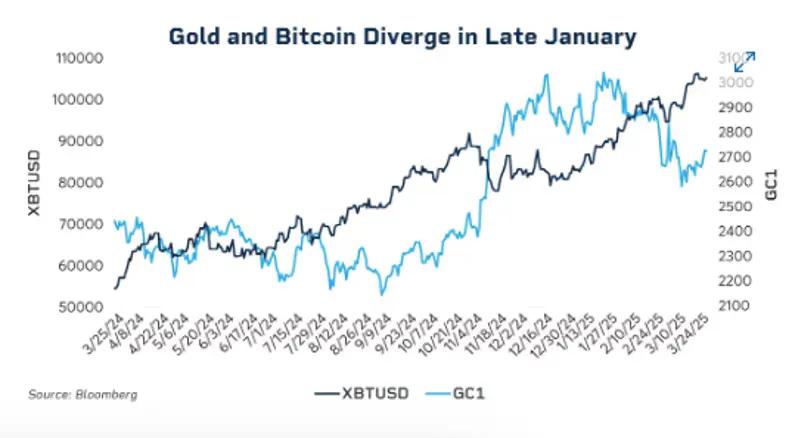
Source: CME Group (Bloomberg data) — Gold and Bitcoin Diverge in Late January. Black line: XBTUSD (Bitcoin); Blue line: GC1 (Gold Futures). The chart shows gold rising while Bitcoin declined from late January 2025.
The correlation breakdown is structural, not temporary. Bitcoin now correlates approximately 0.76 with the Nasdaq, behaving like a high-beta technology asset rather than a safe haven. Gold maintains a correlation of approximately 0.01 with the S&P 500, confirming its role as a true non-correlated hedge. This is precisely why a combined portfolio works — the two assets respond to fundamentally different market drivers.
The RBI has been aggressively accumulating gold, increasing reserves to 880.52 tonnes by March 2026 — including a 18-tonne purchase in February 2026 alone. Globally, 68% of central banks plan to increase gold holdings in 2026. This institutional demand is a price floor that Bitcoin lacks.
Returns Comparison: Short-Term Gold Dominance vs Long-Term Bitcoin Outperformance
The returns picture depends entirely on the time horizon. In 2025, gold was the clear winner. Over a decade, Bitcoin dwarfs every traditional asset class.
Metric | Gold | Bitcoin |
2025 Return | +65% | -6.4% |
10-Year CAGR | ~11% | ~71.5% |
Current Price (May 2026) | ~Rs 15,606/gram (24K) | ~$103,000 (~Rs 87 lakh) |
All-Time High | $5,602/oz (Jan 2026) | $126,296 (Oct 2025) |
Max Drawdown (2021-2022) | ~15% | -77.6% |
Correlation to S&P 500 | ~0.01 | ~0.76 |
Primary Risk Hedge | Geopolitical / Inflation | Monetary debasement / Tech adoption |
Volatility (Annualised) | ~15-18% | ~60-80% |
Gold's 10-year CAGR of approximately 11% in India includes the benefit of rupee depreciation — gold is priced in USD globally, and the rupee has weakened from approximately Rs 65 to Rs 90 per dollar over the past decade. Bitcoin's 10-year CAGR of approximately 71.5% reflects its journey from a sub-$500 asset to over $100,000 — an exceptional return that comes with commensurately exceptional risk. An investor who bought Bitcoin at its December 2017 peak waited over three years to break even. A gold investor who bought at the 2020 peak waited approximately 18 months.
The Indian Gold Market in 2026: Record Inflows and Structural Shifts
India's relationship with gold has fundamentally changed over the past two years. What was once primarily physical jewellery demand has shifted toward financialised gold products — ETFs, digital gold, and sovereign gold bonds.
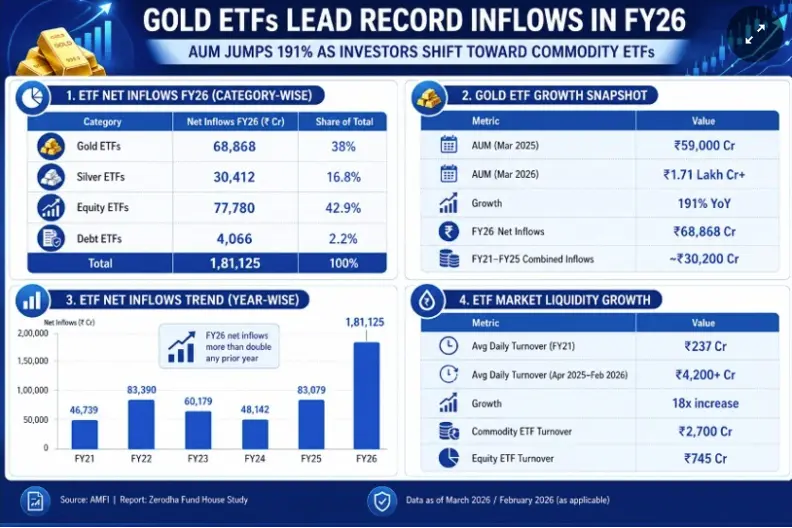
Source: AMFI / BusinessToday — Gold ETFs Lead Record Inflows in FY26. AUM surged 191% to Rs 1.71 lakh crore, with Rs 70,000 crore in net inflows during FY2025-26.
Gold ETF AUM surged 191% in FY26 to Rs 1.71 lakh crore, absorbing Rs 70,000 crore in net inflows — surpassing equity ETF inflows for the first time in January 2026. This shift reflects a broader trend: Indian investors are increasingly treating gold as a portfolio asset rather than a cultural purchase.
Two structural shifts deserve attention. First, no new Sovereign Gold Bond (SGB) tranches will be issued after March 2026 — the government confirmed this in Budget 2025-26, pushing investors toward gold ETFs and digital gold for paper gold exposure. Second, digital gold transactions surged to 219 million UPI transactions in January 2026 alone, indicating that younger investors are entering gold through mobile-first platforms rather than traditional jewellers.
Gold investment demand in India surged 17% in 2025 to 280.4 tonnes, according to the World Gold Council. At current prices of approximately Rs 15,606 per gram (24K), gold remains the single largest asset class in Indian household portfolios after real estate — estimated at over Rs 150 lakh crore in total household gold holdings.
The Combined Portfolio: Why 20% Bitcoin + 80% Gold Beats Both Individually
The most compelling data in the crypto vs gold debate does not argue for one over the other — it argues for both. State Street SPDR research published in 2025 analysed the performance of various Bitcoin-gold portfolio combinations and found that a 20% Bitcoin / 80% gold allocation achieved a Sharpe ratio of 2.94 — significantly outperforming a 100% gold portfolio (Sharpe ~1.2) or 100% Bitcoin portfolio (Sharpe ~0.96) on a risk-adjusted basis.
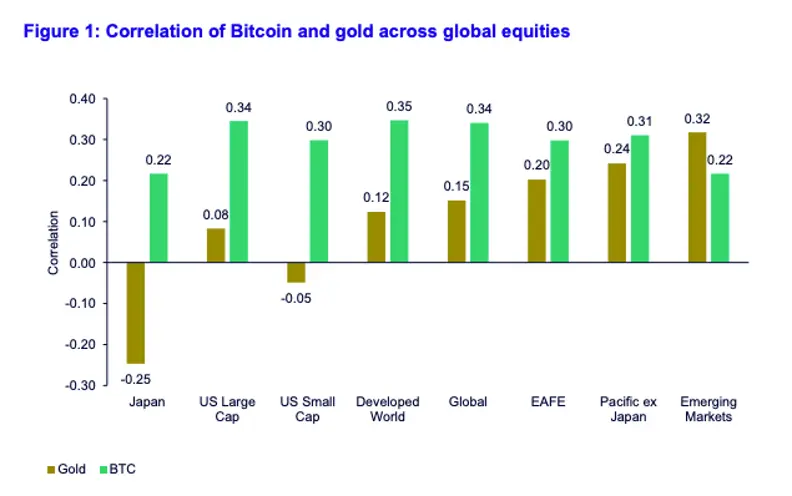
Source: State Street SPDR — Correlation of Bitcoin and Gold Across Global Equities. Gold (dark bars) shows low or negative correlation with equity markets, while Bitcoin (green bars) correlates positively — confirming different risk profiles.
The reason the combined portfolio outperforms is mathematically straightforward: gold and Bitcoin respond to different risk factors. Gold hedges geopolitical risk, inflation, and currency debasement. Bitcoin hedges monetary expansion, technology adoption cycles, and — increasingly — institutional capital flows. When gold rises (geopolitical crisis, inflation spikes), Bitcoin often falls (risk-off sentiment). When Bitcoin surges (bull markets, institutional adoption), gold typically moves sideways. This negative or low correlation is the foundation of portfolio diversification theory — combining uncorrelated assets reduces overall volatility while maintaining expected returns.
The institutional consensus has coalesced around a recommended allocation of 5-10% Bitcoin and 10-15% gold within a diversified portfolio. Morningstar's 2025 analysis concludes that the safe-haven debate has shifted from "gold or Bitcoin" to "gold and Bitcoin serving different portfolio functions" — a framing that removes the false binary entirely.
Tax Treatment in India: Gold vs Crypto in 2026
Tax efficiency is a critical and often overlooked dimension of the crypto vs gold comparison in India. The current tax framework creates significant differences in post-tax returns depending on the instrument and holding period.
Tax Parameter | Physical Gold / Gold ETF | Sovereign Gold Bond | Crypto (Spot / VDA) | Crypto Derivatives |
Tax Rate | 12.5% LTCG (>12 months) | Tax-free on maturity | 30% flat (Section 115BBH) | Slab rates (Section 43(5)) |
Short-Term Tax | Slab rates (<12 months) | Slab rates | 30% flat | Slab rates |
Indexation | No (post Budget 2024) | No | No | N/A (business income) |
Loss Offset | Against LTCG only | N/A | Not allowed | Against speculative income |
Loss Carry-Forward | 8 years | N/A | Not allowed | 4 years |
TDS | None | None | 1% (Section 194S) | None |
Expense Deduction | Limited | N/A | Not allowed | Allowed (business expense) |
The tax structure heavily favours gold over spot crypto for Indian investors. Gold is taxed at 12.5% LTCG after a 12-month holding period (post Budget 2024 changes, which removed indexation but lowered the rate from 20%). SGBs remain tax-free on maturity redemption — though no new tranches will be issued after March 2026.
Crypto spot is taxed at a punitive flat 30% under Section 115BBH, with no deductions, no loss offset, no carry-forward, and an additional 1% TDS on every transaction under Section 194S. However, crypto derivatives — futures and options — are classified as speculative business income under Section 43(5) and taxed at income slab rates. This creates a structurally lower tax burden: an investor in the 30% slab pays the same rate but gains access to business expense deductions, loss offset against other speculative income, and four-year loss carry-forward — advantages completely unavailable to spot crypto investors.
Risk Profile Comparison: Volatility, Drawdowns, and Recovery
The risk profiles of gold and Bitcoin are fundamentally different in magnitude, not just direction.
Risk Metric | Gold | Bitcoin |
Annualised Volatility | ~15-18% | ~60-80% |
Max Drawdown (2022) | ~15% | -77.6% |
Typical Recovery Time | 6-18 months | 16-36 months |
Regulatory Risk | Minimal (established) | High (evolving globally) |
Custody Risk | Low (physical/ETF/locker) | Moderate (exchange/self-custody) |
Counterparty Risk | Low (physical gold) | Moderate (exchange failures — FTX, 3AC) |
Liquidity | Very high (24/7 global market) | High (but volatile spreads in crashes) |
Correlation to Equities | ~0.01 (near zero) | ~0.76 (high, Nasdaq-like) |
Bitcoin's annualised volatility of 60-80% is roughly four to five times that of gold. In the 2021-2022 cycle, Bitcoin fell 77.6% from its all-time high while gold dropped approximately 15%. Bitcoin's recovery from the November 2022 bottom to a new ATH took roughly 24 months; gold's recovery from its 2022 dip took about 12 months. For Indian investors, this volatility difference has a direct practical implication: a Rs 10 lakh Bitcoin allocation could temporarily decline to Rs 2.24 lakh during a severe drawdown, while a Rs 10 lakh gold allocation would likely bottom at Rs 8.5 lakh.
However, volatility is not inherently negative if it is managed. Professional derivatives strategies — options hedging, delta-neutral positions, systematic rebalancing, can capture Bitcoin's upside while limiting drawdowns to levels closer to gold's risk profile. This is precisely what managed crypto portfolios like Grade Capital aim to achieve, and why the risk-adjusted return (Sharpe ratio) matters more than raw returns for portfolio construction.
What This Means for Indian Investors: A Practical Allocation Framework
The question is not whether to own gold or crypto — it is how to allocate between them based on your risk tolerance, time horizon, and tax situation.
Conservative allocation (low risk tolerance, 3-5 year horizon): 10-15% gold (via ETFs or remaining SGBs), 2-5% crypto (via managed derivatives). The gold allocation provides stability and a proven inflation hedge with favourable 12.5% LTCG tax treatment. A small crypto derivatives allocation adds asymmetric upside potential while being taxed at slab rates under Section 43(5).
Moderate allocation (medium risk tolerance, 5-10 year horizon): 10-15% gold, 5-10% crypto. Over longer horizons, Bitcoin's 71.5% CAGR overwhelms gold's 11%, even accounting for higher volatility. The crypto allocation should prioritise managed exposure — platforms like Grade Capital offer structured crypto derivatives portfolios that combine institutional risk management with the tax efficiency of Section 43(5).
Aggressive allocation (high risk tolerance, 10+ year horizon): 10% gold, 10-15% crypto. For investors with long time horizons who can withstand 70%+ drawdowns, a higher crypto allocation captures the asset class's structural growth trajectory. Even in this case, gold provides non-correlated ballast that reduces portfolio-level volatility.
Grade Capital's mention is not to abandon gold for crypto or vice versa. Grade Capital's managed baskets give you structured crypto exposure like a gold ETF — not raw speculation. Just as gold ETFs democratised access to institutional gold investing, managed crypto derivatives portfolios provide access to professional-grade crypto exposure with hedging, custody, and tax optimisation built in.
Disclaimer: This content is for informational and educational purposes only and does not constitute financial advice or an offer to invest. Past performance is not indicative of future results. The data presented uses publicly available market data and research reports; actual individual returns may vary based on entry points, holding periods, and market conditions. Tax treatment depends on individual circumstances and the prevailing interpretation of tax laws. Investors are advised to consult qualified tax and investment professionals. Return projections and historical statistics are estimates and not forecasts of actual future performance.