
How to Legally Reduce Crypto Tax from 30% to 15% in India
Indian investors can legally reduce crypto tax from 30% to as low as 15% — and the mechanism is already in the Income Tax Act. Section 115BBH imposes a flat 30% tax on every transfer of a Virtual Digital Asset (VDA), regardless of income level, holding period, or the size of the gain. An investor earning ₹ 5 lakh in crypto gains pays the same 30% rate as one earning ₹ 5 crore.
There is, however, a legal route to reduce crypto tax to as low as 5 to 15% — depending on total income. It runs through crypto derivatives, and it is grounded in the distinction between Section 115BBH and Section 43(5) of the same Act.
The 30% Problem: How Section 115BBH Works Against You
Section 115BBH is among the most punitive tax provisions in Indian financial law. It imposes four constraints that no other asset class in India faces simultaneously.
First: a flat 30% tax on gains, plus 4% health and education cess. No slab-based calculation. No reduced rate for long-term holding.
Second: no loss offset. Losses from one crypto asset cannot reduce gains from another. A trader who makes ₹ 3 lakh on Bitcoin and loses ₹ 2 lakh on Ethereum pays 30% tax on the full ₹ 3 lakh — not on the net ₹ 1 lakh. The tax liability is ₹ 90,000 on a net gain of ₹ 1 lakh. The effective tax rate: 90%.
Third: no carry forward. Unlike business losses or capital losses, VDA losses cannot be carried forward to future assessment years. They expire in the year they are incurred.
Fourth: 1% TDS on every transaction above ₹ 50,000 under Section 194S. This creates a constant liquidity drain — capital is locked in TDS claims that must be recovered during ITR filing.
A peer-reviewed study by Khan (2026), published in the Journal of Management & Social Science, quantified the impact. India's 30% flat tax caused a 90% drop in domestic crypto trading volumes within two weeks of implementation.
The study — based on 17 validated sources including NBER working papers, IRS data, and international regulatory reports — confirmed that aggressive flat-rate taxation drives trading to offshore platforms without proportionate revenue. Indian users traded VDAs worth over $42 billion on offshore exchanges between July 2022 and July 2023. Only $0.84 million in TDS was collected from foreign platforms — 0.02% of the estimated $4.2 billion in lost revenue. The 30% rate did not reduce crypto tax evasion. It relocated it.
The Legal Route to Reduce Crypto Tax: Derivatives Under Section 43(5)
The mechanism to reduce crypto tax is not a loophole. It is a structural feature of how the Income Tax Act classifies different types of financial transactions.
Section 115BBH applies specifically to "income from transfer of any virtual digital asset." The operative word is transfer. A spot crypto trade — buying Bitcoin on an exchange, holding it, and selling it — constitutes a transfer of a VDA. The 30% flat tax applies.
A crypto derivative contract — a futures or options position — does not involve a transfer of the underlying VDA. The investor never takes ownership of the digital asset. The contract is cash-settled in INR: the profit or loss is the difference between entry and exit price. No VDA changes hands.
This distinction is critical. Because no VDA transfer occurs, Section 115BBH does not apply to crypto derivatives. The income falls instead under Section 43(5) of the Income Tax Act — classified as speculative business income, because crypto exchanges are not recognised stock exchanges under the Securities Contracts Regulation Act (SCRA).
Speculative business income is taxed at the investor's individual slab rate. Not at 30% flat. This is the legal basis that allows investors to reduce crypto tax by choosing derivatives over spot.
How to Reduce Crypto Tax: New Regime Slab Rates vs 30% Flat
The new tax regime under Section 115BAC — the default regime since FY 2024-25 — uses the following slab structure for FY 2025-26:
Income Bracket | Tax Rate | Compared to Section 115BBH |
Up to ₹ 4 lakh | 0% | Saves 30% |
₹ 4 – 8 lakh | 5% | Saves 25% |
₹ 8 – 12 lakh | 10% | Saves 20% |
₹ 12 – 16 lakh | 15% | Saves 15% |
₹ 16 – 20 lakh | 20% | Saves 10% |
₹ 20 – 24 lakh | 25% | Saves 5% |
Above ₹ 24 lakh | 30% | No saving |
Section 87A provides a rebate of up to ₹ 60,000 — making taxable income up to ₹ 12 lakh effectively tax-free under the new regime. For salaried individuals, the ₹ 75,000 standard deduction extends this to ₹ 12.75 lakh.
The arithmetic is direct. An investor with total taxable income of ₹ 15 lakh — including crypto derivatives gains — pays 15% on the portion falling in the ₹ 12-16 lakh bracket. The same gain from spot crypto would attract 30%. The tax saving is 50%.
Consider a concrete example. An investor earns ₹ 10 lakh in salary and ₹ 4 lakh in crypto derivatives gains — total income ₹ 14 lakh. Under the new regime, the first ₹ 4 lakh is tax-free, ₹ 4-8 lakh at 5%, ₹ 8-12 lakh at 10%, and ₹ 12-14 lakh at 15%. Total tax on the full ₹ 14 lakh: approximately ₹ 1,10,000.
If the same ₹ 4 lakh were spot crypto gains under Section 115BBH, the tax on that portion alone would be ₹ 1,20,000 plus cess — before any tax on salary income. The investor who chose to reduce crypto tax through derivatives saves more on the ₹ 4 lakh crypto portion than the total tax on their ₹ 10 lakh salary.
Five Tax Advantages of Crypto Derivatives Over Spot Trading
The slab rate is only one of five structural advantages that help reduce crypto tax when income falls under Section 43(5) instead of Section 115BBH.
1. Slab-based taxation instead of 30% flat. The effective rate ranges from 0% to 30% depending on total income — compared to a fixed 30% regardless of income under Section 115BBH. For most Indian taxpayers earning under ₹ 24 lakh, derivatives offer a lower rate.
2. Loss offset against speculative income. Under Section 73, losses from crypto derivatives can be set off against gains from other speculative transactions in the same financial year. Section 115BBH permits no loss offset of any kind.
3. Carry forward of losses for 4 years. Unabsorbed speculative losses under Section 73 can be carried forward for up to four assessment years and set off against future speculative income. VDA losses under Section 115BBH expire immediately.
4. Business expense deductions. Crypto derivatives income, classified as business income, allows deductions for expenses incurred wholly and exclusively for trading — brokerage fees, internet charges, subscription costs, platform fees, and related administrative expenses. Section 115BBH allows only cost of acquisition as a deduction.
5. No 1% TDS. Section 194S mandates 1% TDS on VDA transfers. Crypto derivatives — being cash-settled contracts, not VDA transfers — are exempt from this provision. For investors seeking to reduce crypto tax burden, this means capital remains fully deployed rather than locked in TDS claims.
How Managed Crypto Portfolios Help Reduce Crypto Tax Legally
The derivatives tax advantage is not limited to individual traders executing futures contracts. It extends to managed crypto portfolios that operate primarily through derivatives strategies.
A professionally managed crypto fund that uses futures, options, straddles, and strangles generates income classified under Section 43(5) — not Section 115BBH. The investor gains exposure to crypto price movements without directly buying or selling VDAs. The tax treatment follows the instrument, not the underlying asset.
The PwC/AIMA 6th Annual Global Crypto Hedge Fund Report (2024) documents this shift at the institutional level. 58% of crypto hedge funds now use derivatives — up from 38%. Spot-only trading dropped to 25%. The institutional migration toward derivatives is driven by two factors: risk management and tax efficiency.
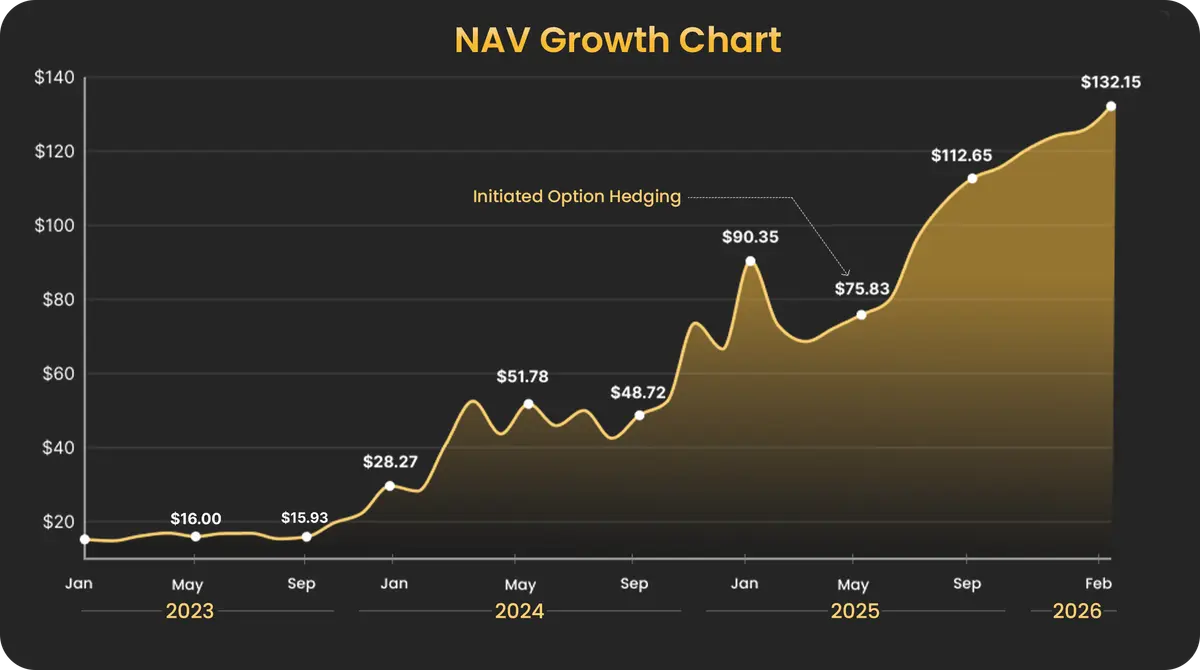
Grade Capital operates on this model — using derivatives-based strategies with daily NAV tracking, starting at ₹ 12,000. For investors in the ₹ 8-20 lakh income range, the tax differential between spot and derivatives exposure can represent a 10 to 20 percentage point reduction in effective tax rate on the same underlying crypto market.
The Risks and Caveats: What You Must Know
The ability to reduce crypto tax through derivatives reflects current Chartered Accountant consensus and prevailing interpretation of the Income Tax Act. It is not without caveats.
CBDT has not issued a specific circular or notification classifying crypto derivatives under Section 43(5). The classification rests on the legal argument that INR-settled crypto futures do not constitute a "transfer of VDA" — and therefore fall outside Section 115BBH.
This argument is supported by the plain reading of the statute and by the majority of tax professionals. It has not, however, been tested in appellate tribunals.
The OECD's Crypto-Asset Reporting Framework — to which India is a signatory — will bring 75 jurisdictions into a data-sharing network by 2027. The OECD's 2020 report on taxing virtual currencies noted that most countries classify crypto as property, and a minority distinguish between business activity (income tax) and personal activity (capital gains). India's approach of treating all crypto alike under Section 115BBH is an outlier.
Future budget amendments could reclassify crypto derivatives under Section 115BBH. Investors should monitor CBDT circulars and Finance Bill provisions annually. Any crypto tax strategy should be executed in consultation with a qualified Chartered Accountant.
The global direction, however, is toward nuance — not toward flat rates. The OECD recommends simplified rules, exemption thresholds for small trades, and alignment of crypto taxation with broader tax policy objectives.
India's own regulatory conversation with SEBI and RBI is moving toward a more structured framework. The current 30% flat rate is a transitional measure. Investors who reduce crypto tax through derivatives today are positioning themselves within a structure the law already permits — and that global precedent supports.
The Bottom Line
The ability to reduce crypto tax is built into the Income Tax Act itself. Section 115BBH taxes spot crypto at 30% flat — no loss offset, no carry forward, no deductions. Section 43(5) taxes crypto derivatives income at slab rates — with loss offset, carry forward, and expense deductions.
For an Indian investor in the ₹ 12-16 lakh income bracket, this is the difference between 30% and 15%. For those under ₹ 12 lakh, it could mean paying 0 to 10% instead of 30%.
The law does not prohibit this structure. It creates it. The Income Tax Act itself distinguishes between a VDA transfer and a cash-settled derivative contract.
Investors who want to reduce crypto tax legally have two paths: trade derivatives directly — which requires market expertise and 24/7 monitoring — or invest through managed crypto portfolios that operate under Section 43(5).
Explore how derivatives-based crypto portfolios reduce crypto tax at grade.capital.