Last Updated: May 2026
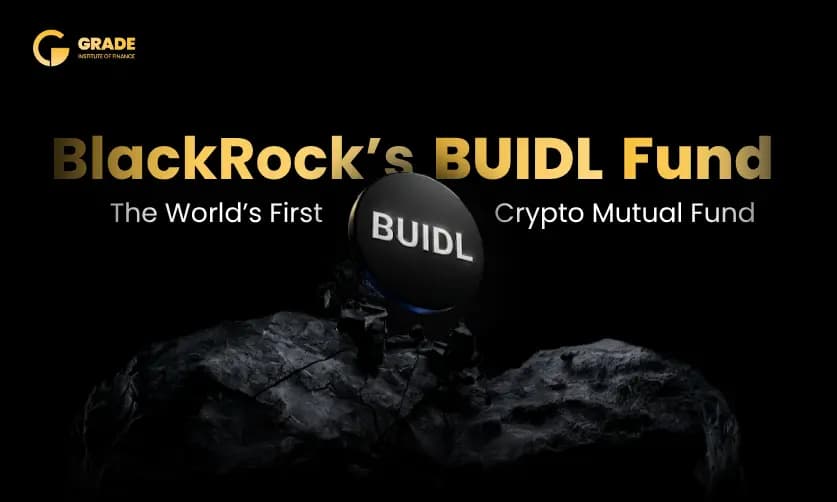
BlackRock's BUIDL Fund: The World's First Tokenized Mutual Fund (and Why India Can't Access It)
The BlackRock BUIDL fund — officially the USD Institutional Digital Liquidity Fund — is now available across nine blockchains globally but remains inaccessible in India. It is the world's largest tokenized money market fund, managing over $2.5 billion in assets entirely on blockchain. It invests in US Treasury bills and repo agreements, settles trades 24/7/365, and pays daily yield directly to investor wallets as newly minted tokens. For all practical purposes, it functions as a crypto-native mutual fund — but one built on blockchain infrastructure rather than legacy settlement systems.
India, home to 119 million crypto owners and ranked first on the Chainalysis Global Crypto Adoption Index for three consecutive years, cannot access BUIDL or any similar product. There is no regulatory pathway for tokenized funds in India, no SEBI framework for blockchain-settled mutual funds, and the RBI remains opposed to any formal recognition of virtual digital assets.
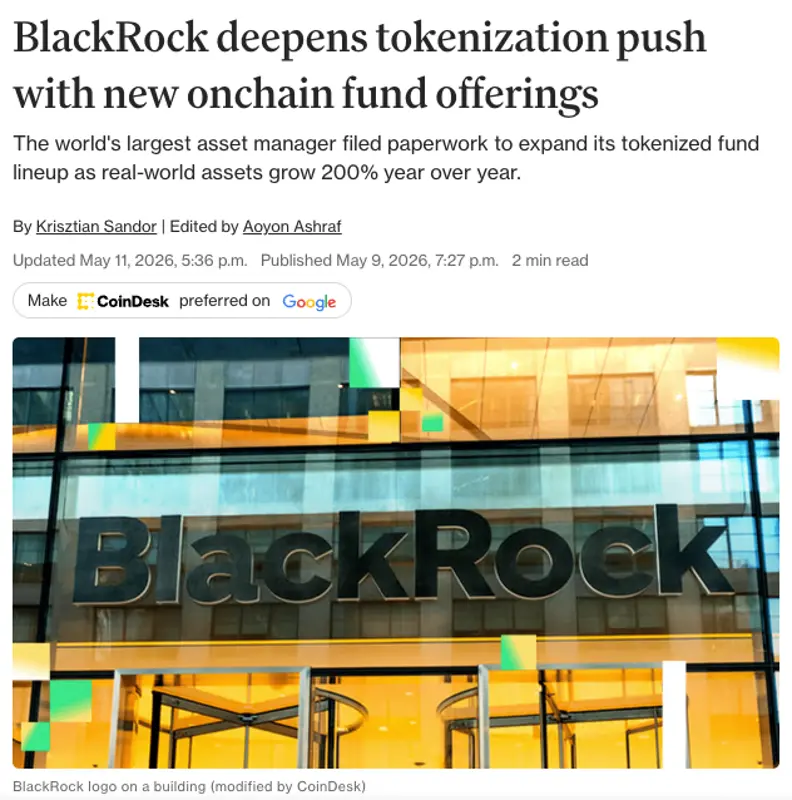
Source: CoinDesk — BlackRock deepens tokenization push with new on-chain fund offerings (May 2026)
What Is BlackRock's BUIDL Fund and How Does It Work?
BUIDL was launched in March 2024 through a partnership between BlackRock and Securitize, a blockchain-native securities platform. BlackRock, the world's largest asset manager with over $11.5 trillion in total AUM, led a $47 million funding round in Securitize before launching BUIDL — signalling that tokenization is not a side project but a strategic priority.
The fund invests exclusively in US Treasury bills, Treasury repos, and cash equivalents. It maintains a stable $1.00 per token NAV. Dividends accrue daily and are distributed to investor wallets as newly minted BUIDL tokens at the end of each month. The fund has distributed over $100 million in dividends since inception.
What makes BUIDL fundamentally different from a traditional money market fund is its settlement infrastructure. Shares are issued as ERC-20 tokens on Ethereum and are now available across nine blockchains including Solana, Avalanche, Arbitrum, Optimism, Polygon, Aptos, and BNB Chain. Securitize Transfer Agent LLC maintains the official ownership records on-chain, replacing the traditional transfer agent model entirely.
Bank of New York Mellon serves as the fund's custodian for the underlying Treasury assets. Investors subscribe and redeem through Securitize's whitelisted wallet infrastructure — only KYC-verified, accredited investors with approved blockchain addresses can hold or transfer BUIDL tokens. The minimum investment is $5 million, and only qualified purchasers under SEC Regulation D (Rule 506(c)) are eligible.
Why BUIDL Is Effectively a Tokenized Mutual Fund
The term tokenized mutual fund is not marketing language — it describes BUIDL's structure accurately. The fund pools investor capital, invests in a defined asset class (government securities), calculates a daily NAV, distributes income, and uses a regulated transfer agent for ownership records. These are the defining characteristics of a mutual fund.
The difference is the rails. Instead of CAMS or KFintech processing unit creation through a registrar, Securitize issues on-chain tokens. Instead of T+1 or T+2 settlement through clearing corporations, BUIDL settles near-instantly on blockchain. Instead of quarterly dividend payments via bank transfer, yield flows daily to wallets.
Traditional Mutual Fund vs. BlackRock BUIDL: A Structural Comparison
Feature | Traditional Mutual Fund | BlackRock BUIDL |
Settlement | T+1 to T+3 via clearing corporation | Near-instant on blockchain (24/7/365) |
Transfer Agent | CAMS / KFintech (India); BNY Mellon (US) | Securitize Transfer Agent LLC (on-chain) |
NAV Calculation | End-of-day (3:30 PM cut-off) | Real-time on-chain; $1.00 stable NAV |
Dividend Distribution | Monthly/quarterly via bank transfer | Daily accrual; monthly mint to wallet |
Settlement Hours | Business days only | 24/7/365 including weekends/holidays |
Minimum Investment | Rs 500 (India SIP) | $5 million USDC |
Custody | Depository (CDSL/NSDL) | BNY Mellon (assets) + self-custody (tokens) |
Investor Verification | KYC via PAN + Aadhaar | KYC/AML via Securitize + wallet whitelisting |
Transparency | Monthly factsheet | Real-time on-chain verification |
Interoperability | Single registrar system | 9 blockchains via Wormhole/LayerZero |
BlackRock's May 2026 Expansion: BSTBL and BRSRV Filings
On May 8, 2026, BlackRock filed with the US SEC for two additional tokenized fund structures, deepening its commitment to on-chain fund offerings.
BSTBL (BlackRock Select Treasury Based Liquidity Fund) is the tokenized version of an existing $6.1 billion money market fund. BSTBL will issue ERC-20 tokens on Ethereum alongside the fund's traditional share classes, investing in cash and sub-93-day US Treasuries. Total fees, after waivers valid through June 2026, stand at 0.27%.
BRSRV (BlackRock Daily Reinvestment Stablecoin Reserve Vehicle) is an entirely new, blockchain-native money market fund designed specifically for stablecoin holders seeking regulated yield. BRSRV will launch across multiple blockchains and targets a $3 million minimum investment. It holds cash, sub-93-day Treasuries, and overnight Treasury repos.
Both filings use Securitize's blockchain infrastructure for issuance and transfer agency. The SEC filing outlines a model where blockchain-based ownership records integrate with regulated investor onboarding — what the industry calls "OnChain Shares." Larry Fink has publicly stated that tokenization represents the next generation of market infrastructure.
The $13.4 Billion Tokenized Treasury Market: Where BUIDL Sits
BUIDL does not operate in isolation. The global market for tokenized US Treasuries has surpassed $13.4 billion as of May 2026, growing from under $1 billion in early 2023. The broader tokenized real-world asset (RWA) market has crossed $31.4 billion. BCG and Standard Chartered project the tokenized asset market could reach $16 trillion by 2030.
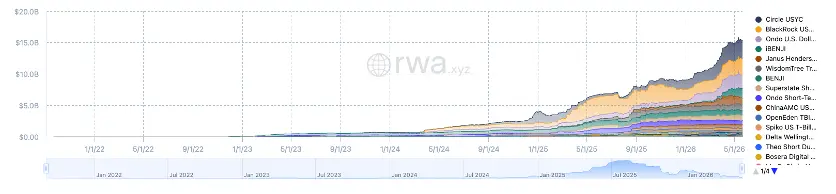
Source: RWA.xyz — Tokenized US Treasuries market growth (Jan 2022 to May 2026)
Tokenized Treasury Fund Landscape (May 2026)
Fund | Issuer | AUM (Approx.) | Blockchains | Min. Investment |
BUIDL | BlackRock / Securitize | $2.5 billion | 9 chains | $5 million |
USYC | Circle (Hashnote) | $2.9 billion | Ethereum, Solana | Varies |
OUSG / USDY | Ondo Finance | $2.6 billion | Multiple | $100,000 |
BENJI / iBENJI | Franklin Templeton | $1.0 billion | Stellar, Polygon, Avalanche | $20 (retail) |
BSTBL | BlackRock (filed May 2026) | Part of $6.1B fund | Ethereum | TBD |
BRSRV | BlackRock (filed May 2026) | New fund | Multiple | $3 million |
Franklin Templeton's BENJI fund is notable for offering retail access with a minimum investment as low as $20 — a model that BUIDL's $5 million threshold explicitly excludes. The contrast is instructive: tokenization technology is ready for retail, but the regulatory and commercial frameworks remain largely institutional.
Why Indian Investors Cannot Access the BlackRock BUIDL Fund
India's exclusion from BUIDL and the broader tokenized fund ecosystem is not accidental — it is structural. Three distinct barriers prevent Indian investors from participating.
1. No Regulatory Framework for Tokenized Funds
The SEBI (Mutual Funds) Regulations, 2026 — which came into force on April 1, 2026 — define the permitted investment universe for Indian mutual funds under the Seventh Schedule. This schedule lists equities, government securities, corporate bonds, REITs, InvITs, gold, silver, and other traditional instruments. Virtual digital assets (VDAs), blockchain tokens, and tokenized securities are not included. There is no provision for on-chain settlement, blockchain-based NAV computation, or tokenized unit creation.
2. RBI Opposition and Regulatory Deadlock
The Reserve Bank of India remains opposed to any regulation or permission for VDA operations in the country. A crypto regulation discussion paper that was in final drafting stages was shelved again by April 2026 after the RBI reportedly blocked it. Without even a basic legal definition of whether crypto is a commodity, security, or currency, the idea of a blockchain-settled mutual fund structure remains outside the scope of Indian financial regulation.
3. Capital Flight Instead of Capital Formation
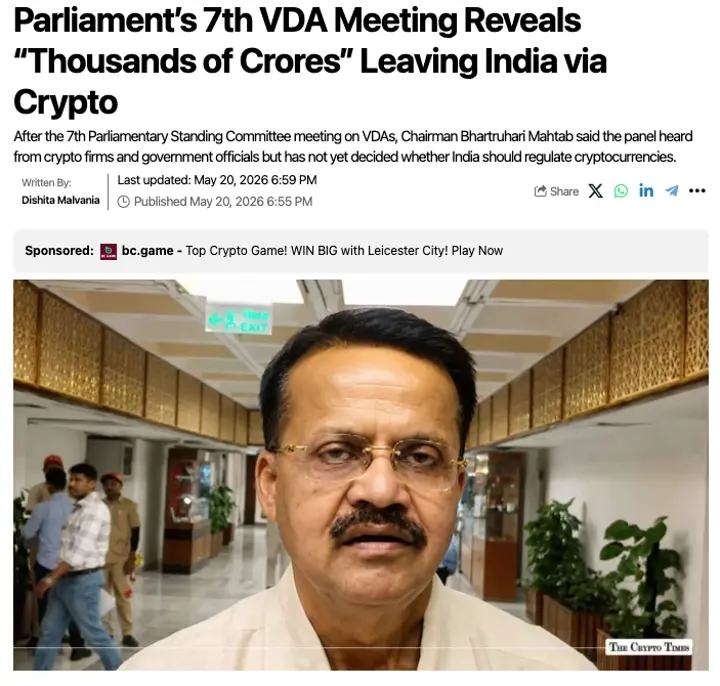
Source: The Crypto Times — Parliament Standing Committee 7th VDA meeting (May 20, 2026)
The consequences of this regulatory gap became starkly visible on May 20, 2026, when Parliament's Standing Committee on Finance held its 7th sitting on VDAs. Committee Chairman Bhartruhari Mahtab stated that "thousands of crores" are flowing out of India through VDA investments — describing the capital flight as "very alarming."
Approximately 90% of Indian VDA trading volume occurs on offshore platforms outside India's regulatory jurisdiction. MP Raghav Chadha noted during the Union Budget 2026-27 debates that nearly 73% of VDA trading now takes place on foreign exchanges, over 180 Indian crypto startups have moved abroad, and around 12 crore investors use offshore platforms. The CBDT has identified approximately Rs 888.82 crore in undisclosed VDA income and issued notices to over 44,000 taxpayers.
Products like BUIDL are precisely the kind of institutional-grade, regulated investment that Indian capital is flowing towards through offshore channels — because no domestic equivalent exists.
What Would SEBI Need to Change for India to Have Tokenized Funds?
Creating a regulatory pathway for tokenized mutual funds in India would require at least five structural amendments, based on how BUIDL operates under US securities law and how the SEBI (Mutual Funds) Regulations 2026 are currently structured.
Requirement | Current Position | What Must Change |
Permitted Asset Universe | Seventh Schedule excludes VDAs and tokenized securities | Add tokenized government securities and blockchain-settled instruments |
Settlement Infrastructure | Clearing corporations (NSE/BSE) only | Recognise blockchain settlement with regulated validators |
Transfer Agent Model | CAMS/KFintech under SEBI registration | Allow on-chain transfer agents (Securitize-equivalent) |
NAV Computation | End-of-day via AMC; 3:30 PM cut-off | Permit real-time on-chain NAV with auditable smart contracts |
Custody Framework | CDSL/NSDL via depository participants | Qualified crypto custodians (Fireblocks, Coinbase) with SEBI registration |
KYC/AML for On-Chain | PAN-Aadhaar via KRA | Wallet whitelisting + on-chain identity verification via FIU-IND |
Each of these changes has precedent. The EU's MiCA framework already provides for crypto-asset service provider (CASP) authorisation. The US SEC has allowed tokenized fund structures under existing securities law. Singapore's MAS has a licensing framework for digital payment token services. India, as Parliamentary Committee Chairman Mahtab acknowledged, does not fall neatly into any of the three global categories — countries that regulate crypto, countries that ban it, or countries that manage it through existing frameworks.
What This Means for Indian Investors and the Mutual Fund Industry
India's mutual fund industry manages over Rs 73.73 lakh crore (approximately $790 billion) in assets under management as of FY2025-26. Monthly SIP flows have crossed Rs 32,087 crore. This is a mature, sophisticated market with deep retail penetration.
Tokenization does not threaten this market — it extends it. The underlying value proposition of a mutual fund (pooled capital, professional management, regulated structure, daily NAV) is preserved in BUIDL. What changes is the infrastructure: faster settlement, lower operational costs, 24/7 availability, and composability with the broader blockchain ecosystem.
The gap between India's crypto adoption (first globally) and its crypto regulation (no comprehensive framework) means that Indian investors seeking institutional-grade digital asset exposure must use offshore platforms. This is precisely the capital flight pattern that the Parliamentary Committee has flagged as alarming.
For investors interested in professionally managed crypto exposure within a compliant framework, platforms like Grade Capital offer managed crypto derivatives portfolios that work within India's existing tax and regulatory structure — providing institutional-grade risk management without requiring investors to navigate offshore jurisdictions.
The Bottom Line
BlackRock's BUIDL fund is not an experiment. It is a $2.5 billion, SEC-regulated, institutionally-backed product that has fundamentally demonstrated that mutual fund structures can operate on blockchain rails. The May 2026 BSTBL and BRSRV filings confirm that BlackRock views tokenization as the future of asset management — not a niche crypto product.
India's 119 million crypto owners, its $790 billion mutual fund industry, and its first-place ranking in global crypto adoption suggest that demand for such products exists. What does not exist — yet — is the regulatory infrastructure to supply them domestically.
The question is no longer whether tokenized funds will become mainstream. BUIDL has answered that. The question is whether India will build the framework to participate in this transition — or continue watching its capital flow offshore.
Want to learn more about institutional-grade crypto investing? Explore the Grade Capital Knowledge Hub for research-backed analysis on crypto regulation, tokenization, and portfolio strategy.
Disclaimer: This content is for informational and educational purposes only and does not constitute financial advice or an offer to invest. Past performance is not indicative of future results. Tax treatment depends on individual circumstances and the prevailing interpretation of tax laws. Investors are advised to consult with qualified tax professionals. Projections and forward-looking statements are estimates and not forecasts of actual performance.